


Page 1033 - Advanced Organic Chemistry Part B - Reactions & Synthesis
P. 1033
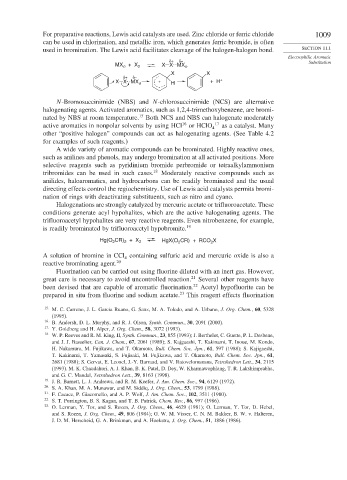
For preparative reactions, Lewis acid catalysts are used. Zinc chloride or ferric chloride  1009
              can be used in chlorination, and metallic iron, which generates ferric bromide, is often
              used in bromination. The Lewis acid facilitates cleavage of the halogen-halogen bond.  SECTION 11.1
                                                                                       Electrophilic Aromatic
                                                    δ+  δ–                                    Substitution
                                    MX   +  X 2   XX MX n
                                      n
                                                    X          X
                                      δ+  δ–
                                    XX MX  n     +  H           +  H +

                  N-Bromosuccinimide (NBS) and N-chlorosuccinimide (NCS) are alternative
              halogenating agents. Activated aromatics, such as 1,2,4-trimethoxybenzene, are bromi-
              nated by NBS at room temperature. 15  Both NCS and NBS can halogenate moderately
              active aromatics in nonpolar solvents by using HCl 16  or HClO  17  as a catalyst. Many
                                                                 4
              other “positive halogen” compounds can act as halogenating agents. (See Table 4.2
              for examples of such reagents.)
                  A wide variety of aromatic compounds can be brominated. Highly reactive ones,
              such as anilines and phenols, may undergo bromination at all activated positions. More
              selective reagents such as pyridinium bromide perbromide or tetraalkylammonium
              tribromides can be used in such cases. 18  Moderately reactive compounds such as
              anilides, haloaromatics, and hydrocarbons can be readily brominated and the usual
              directing effects control the regiochemistry. Use of Lewis acid catalysts permits bromi-
              nation of rings with deactivating substituents, such as nitro and cyano.
                  Halogenations are strongly catalyzed by mercuric acetate or trifluoroacetate. These
              conditions generate acyl hypohalites, which are the active halogenating agents. The
              trifluoroacetyl hypohalites are very reactive reagents. Even nitrobenzene, for example,
              is readily brominated by trifluoroacetyl hypobromite. 19

                               Hg(O CR)   +  X 2  HgX(O CR)  +  RCO X
                                   2
                                      2
                                                                2
                                                       2
              A solution of bromine in CCl containing sulfuric acid and mercuric oxide is also a
                                      4
              reactive brominating agent. 20
                  Fluorination can be carried out using fluorine diluted with an inert gas. However,
              great care is necessary to avoid uncontrolled reaction. 21  Several other reagents have
              been devised that are capable of aromatic fluorination. 22  Acetyl hypofluorite can be
              prepared in situ from fluorine and sodium acetate. 23  This reagent effects fluorination
              15   M. C. Carreno, J. L. Garcia Ruano, G. Sanz, M. A. Toledo, and A. Urbano, J. Org. Chem., 60, 5328
                 (1995).
              16
                 B. Andersh, D. L. Murphy, and R. J. Olson, Synth. Commun., 30, 2091 (2000).
              17   Y. Goldberg and H. Alper, J. Org. Chem., 58, 3072 (1993).
              18   W. P. Reeves and R. M. King, II, Synth. Commun., 23, 855 (1993); J. Berthelot, C. Guette, P. L. Desbene,
                 and J. J. Basselier, Can. J. Chem., 67, 2061 (1989); S. Kajgaeshi, T. Kakinami, T. Inoue, M. Kondo,
                 H. Nakamura, M. Fujikawa, and T. Okamoto, Bull. Chem. Soc. Jpn., 61, 597 (1988); S. Kajigaeshi,
                 T. Kakinami, T. Yamasaki, S. Fujisaki, M. Fujikawa, and T. Okamoto, Bull. Chem. Soc. Jpn., 61,
                 2681 (1988); S. Gervat, E. Leonel, J.-Y. Barraud, and V. Ratovelomanana, Tetrahedron Lett., 34, 2115
                 (1993). M. K. Chaudahuri, A. J. Khan, B. K. Patel, D. Dey, W. Kharmawophlang, T. R. Lakshimprabha,
                 and G. C. Mandal, Tetrahedron Lett., 39, 8163 (1998).
              19   J. R. Barnett, L. J. Andrews, and R. M. Keefer, J. Am. Chem. Soc., 94, 6129 (1972).
              20   S. A. Khan, M. A. Munawar, and M. Siddiq, J. Org. Chem., 53, 1799 (1988).
              21
                 F. Cacace, P. Giacomello, and A. P. Wolf, J. Am. Chem. Soc., 102, 3511 (1980).
              22   S. T. Purrington, B. S. Kagan, and T. B. Patrick, Chem. Rev., 86, 997 (1986).
              23
                 O. Lerman, Y. Tor, and S. Rozen, J. Org. Chem., 46, 4629 (1981); O. Lerman, Y. Tor, D. Hebel,
                 and S. Rozen, J. Org. Chem., 49, 806 (1984); G. W. M. Visser, C. N. M. Bakker, B. W. v. Halteren,
                 J. D. M. Herscheid, G. A. Brinkman, and A. Hoekstra, J. Org. Chem., 51, 1886 (1986).

