


Page 1044 - Advanced Organic Chemistry Part B - Reactions & Synthesis
P. 1044
1020             alkylbenzenes. 52  The percentage of ortho attack increases with the electrophilicity of
                       the acylium ion and as much as 50% ortho product is observed with the formylium
      CHAPTER 11                                 53
                       and 2,4-dinitrobenzoylium ions.  Rearrangement of the acyl group is not a problem
      Aromatic Substitution  in Friedel-Craft acylation. Neither is polyacylation, because the first acyl group serves
      Reactions
                       to deactivate the ring to further attack. For these reasons, it is often preferable to
                       introduce primary alkyl groups by a sequence of acylation followed by reduction of
                       the acyl group (see Section 5.7.1).
                           Intramolecular acylations are very common, and the normal conditions involving
                       an acyl halide and Lewis acid can be utilized. One useful alternative is to dissolve
                       the carboxylic acid in polyphosphoric acid (PPA) and heat to effect cyclization. This
                       procedure probably involves formation of a mixed phosphoric-carboxylic anhydride. 54

                                               (CH ) CO H
                                                      2
                                                 2 3
                                                      PPA                O


                       Cyclizations can also be carried out with an esterified oligomer of phosphoric acid
                       called “polyphosphate ester,” which is chloroform soluble. 55  Another reagent of this
                       type is trimethylsilyl polyphosphate (Scheme 11.4, Entry 13). 56  Neat methanesul-
                       fonic acid is also an effective reagent for intramolecular Friedel-Crafts acylation
                       (Scheme 11.4, Entry 14). 57
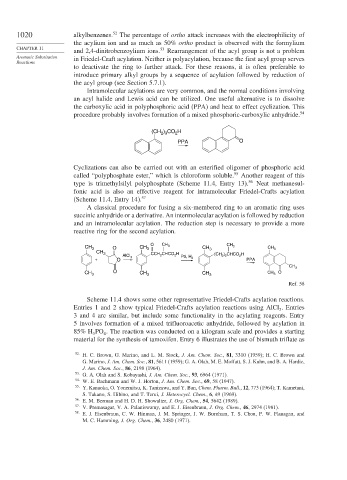
                           A classical procedure for fusing a six-membered ring to an aromatic ring uses
                       succinic anhydride or a derivative. An intermolecular acylation is followed by reduction
                       and an intramolecular acylation. The reduction step is necessary to provide a more
                       reactive ring for the second acylation.

                                              O   CH 3               CH 3
                                   O
                          CH 3             CH 3               CH 3               CH 3
                              CH 3
                                              CCH 2 CHCO 2 H     (CH 2 ) 2 CHCO 2 H
                                      AlCl 3           Pd, H 2
                              +     O                                      PPA
                                                                                        CH 3
                                   O                                                 O
                          CH 3             CH 3               CH 3               CH 3
                                                                                        Ref. 58
                           Scheme 11.4 shows some other representative Friedel-Crafts acylation reactions.
                       Entries 1 and 2 show typical Friedel-Crafts acylation reactions using AlCl . Entries
                                                                                     3
                       3 and 4 are similar, but include some functionality in the acylating reagents. Entry
                       5 involves formation of a mixed trifluoroacetic anhydride, followed by acylation in
                       85% H PO . The reaction was conducted on a kilogram scale and provides a starting
                             3
                                4
                       material for the synthesis of tamoxifen. Entry 6 illustrates the use of bismuth triflate as
                        52
                          H. C. Brown, G. Marino, and L. M. Stock, J. Am. Chem. Soc., 81, 3310 (1959); H. C. Brown and
                          G. Marino, J. Am. Chem. Soc., 81, 5611 (1959); G. A. Olah, M. E. Moffatt, S. J. Kuhn, and B. A. Hardie,
                          J. Am. Chem. Soc., 86, 2198 (1964).
                        53   G. A. Olah and S. Kobayashi, J. Am. Chem. Soc., 93, 6964 (1971).
                        54
                          W. E. Bachmann and W. J. Horton, J. Am. Chem. Soc., 69, 58 (1947).
                        55
                          Y. Kanaoka, O. Yonemitsu, K. Tanizawa, and Y. Ban, Chem. Pharm. Bull., 12, 773 (1964); T. Kametani,
                          S. Takano, S. Hibino, and T. Terui, J. Heterocycl. Chem., 6, 49 (1969).
                        56   E. M. Berman and H. D. H. Showalter, J. Org. Chem., 54, 5642 (1989).
                        57   V. Premasagar, V. A. Palaniswamy, and E. J. Eisenbraun, J. Org. Chem., 46, 2974 (1981).
                        58
                          E. J. Eisenbraun, C. W. Hinman, J. M. Springer, J. W. Burnham, T. S. Chou, P. W. Flanagan, and
                          M. C. Hamming, J. Org. Chem., 36, 2480 (1971).

