


Page 354 - Applied Process Design For Chemical And Petrochemical Plants Volume III
P. 354
66131_Ludwig_CH11A  5/30/2001 4:49 PM  Page 311


                                                                Refrigeration Systems                                      311

                       (1)


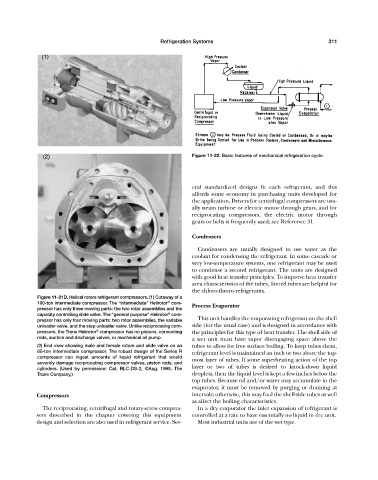
                       (2)                                                 Figure 11-22. Basic features of mechanical refrigeration cycle.


                                                                           eral standardized designs fit each refrigerant, and this
                                                                           affords some economy in purchasing units developed for
                                                                           the application. Drivers for centrifugal compressors are usu-
                                                                           ally steam turbine or electric motor through gears, and for
                                                                           reciprocating compressors, the electric motor through
                                                                           gears or belts is frequently used; see Reference 31.

                                                                           Condensers

                                                                             Condensers are usually designed to use water as the
                                                                           coolant for condensing the refrigerant. In some cascade or
                                                                           very low-temperature systems, one refrigerant may be used
                                                                           to condense a second refrigerant. The units are designed
                                                                           with good heat transfer principles. To improve heat transfer
                                                                           area characteristics of the tubes, finned tubes are helpful for
                                                                           the chloro-fluoro-refrigerants.
                     Figure 11-21D. Helical rotors refrigerant compressors. (1) Cutaway of a
                                                                   ®
                     100-ton intermediate compressor. The “intermediate” Helirotor com-  Process Evaporator
                     pressor has only three moving parts: the two rotor assemblies and the
                                                                   ®
                     capacity controlling slide valve. The “general purpose” Helirotor com-
                     pressor has only four moving parts: two rotor assemblies, the variable  This unit handles the evaporating refrigerant on the shell
                     unloader valve, and the step unloader valve. Unlike reciprocating com-  side (for the usual case) and is designed in accordance with
                     pressors, the Trane Helirotor compressor has no pistons, connecting  the principles for this type of heat transfer. The shell side of
                                          ®
                     rods, suction and discharge valves, or mechanical oil pump.  a wet unit must have vapor disengaging space above the
                     (2) End view showing male and female rotors and slide valve on an  tubes to allow for free surface boiling. To keep tubes clean,
                     85-ton intermediate compressor. The robust design of the Series R  refrigerant level is maintained an inch or two above the top-
                     compressor can ingest amounts of liquid refrigerant that would  most layer of tubes. If some superheating action of the top
                     severely damage reciprocating compressor valves, piston rods, and
                     cylinders. (Used by permission: Cat. RLC-DS-2, ©Aug. 1995. The  layer or two of tubes is desired to knock-down liquid
                     Trane Company.)                                       droplets, then the liquid level is kept a few inches below the
                                                                           top tubes. Because oil and/or water may accumulate in the
                                                                           evaporator, it must be removed by purging or draining at
                     Compressors                                           intervals; otherwise, this may foul the shell-side tubes as well
                                                                           as affect the boiling characteristics.
                       The reciprocating, centrifugal and rotary-screw compres-  In a dry evaporator the inlet expansion of refrigerant is
                     sors described in the chapter covering this equipment  controlled at a rate to have essentially no liquid in the unit.
                     design and selection are also used in refrigerant service. Sev-  Most industrial units are of the wet type.

