


Page 383 - Between One and Many The Art and Science of Public Speaking
P. 383
350                   Part 4  Contexts for Public Speaking


                                          • Auditory numerical: Learning by hearing numbers.
                                          • Visual numerical: Learning by seeing numbers.
                                          •  Audio-visual-kinesthetic combination: Learning by hearing, seeing, and doing
                                           in combination.
                                          • Individual: Learning when by oneself.
                                          • Group: Learning in collaboration with other people.

                                          • Oral expressive: Learning by telling others orally.
                                          • Written expressive: Learning by writing.

                                        At fi rst, such a long list of diverse learning styles may be intimidating. How can
                                        one speech or even a series of speeches adapt to all of these different ways of
                                        learning? Of course, you cannot be all things to all people. But teachers confront
                                        this variety of learning styles every day. Many teachers use a combination of
                                        methods—individual and group work, written and oral assignments, print and
                                        visual materials—in an effort to adapt to the variety of learning styles in their
                                        classrooms.
                                          Rather than trying to guess which learning style is best understood by an
                                        audience, it is better to use multiple channels and modes of learning, much
                                        as we discussed in the preceding chapter. With this method, you are likely to
                                        reach most of your audience members with something that suits their style of
                                        learning. In any given audience, there are likely to be individual learners as
                                        well as group learners, those who respond best to oral instruction and those who
                                                           need to read it, and so on. Using posters, overheads trans-
                                                           parencies, or Power Point™ slides are excellent ways to re-
                                                           inforce visually what we say orally. Distributing a handout
                                                           after, and only after, a speech can help visual learners
                                                           retain what was said. It helps to provide the audience with
                                                           an opportunity to use as many senses as possible to pro-
                                                           cess the message. If parts of the presentation can be seen,
                                                           heard, and even touched, odds increase that the message
                                                           will sink in.
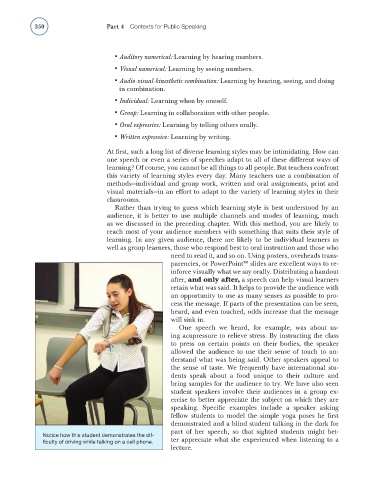
                                                             One speech we heard, for example, was about us-
                                                           ing acupressure to relieve stress. By instructing the class
                                                           to press on certain points on their bodies, the speaker
                                                           allowed the audience to use their sense of touch to un-
                                                           derstand what was being said. Other speakers appeal to
                                                           the sense of taste. We frequently have international stu-
                                                           dents speak about a food unique to their culture and
                                                           bring samples for the audience to try. We have also seen
                                                           student speakers involve their audiences in a group ex-
                                                           ercise to better appreciate the subject on which they are
                                                           speaking. Specifi c examples include a speaker asking
                                                           fellow students to model the simple yoga poses he fi rst
                                                           demonstrated and a blind student talking in the dark for
                                                           part of her speech, so that sighted students might bet-
                     Notice how this student demonstrates the dif-
                     fi culty of driving while talking on a cell phone.  ter appreciate what she experienced when listening to a
                                                           lecture.

