


Page 384 - Between One and Many The Art and Science of Public Speaking
P. 384
Chapter 13  Informative Speaking               351


                    Informative Speaking and Persuasion


                    When you were assigned to read this chapter, it is likely that your instructor also
                    required you to prepare and deliver an informative speech. When is a speech
                    primarily informative, as opposed to being persuasive? Depending on whom
                    you ask, you are likely to get a different answer to this question. Some peo-
                    ple would argue that a speech can be exclusively informative—with no purpose
                    other than one person passing information along to an audience. Still others
                    argue that while the line between what is informative and what is persuasive is
                    blurred, it is nevertheless there.
                       Our position is based on a simple premise. An informative speech is not worth
                    giving unless it is designed to reasonably ensure that it won’t go in one ear and
                    then right out the other. What good, for example, is an informative speech on
                    the proper equipment to safely roller blade if it doesn’t increase the probability
                    of the audience seriously considering the information? Similarly, what good is to
                    be gained by an informative speech on preventive health practices such as using
                    sunscreen regularly if it has no motivational value for an audience?
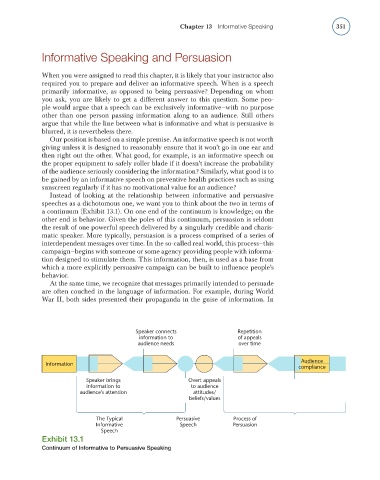
                       Instead of looking at the relationship between informative and persuasive
                    speeches as a dichotomous one, we want you to think about the two in terms of
                    a continuum (Exhibit 13.1). On one end of the continuum is knowledge; on the
                    other end is behavior. Given the poles of this continuum, persuasion is seldom
                    the result of one powerful speech delivered by a singularly credible and charis-
                    matic speaker. More typically, persuasion is a process comprised of a series of
                    interdependent messages over time. In the so-called real world, this process—this
                    campaign—begins with someone or some agency providing people with informa-
                    tion designed to stimulate them. This information, then, is used as a base from
                    which a more explicitly persuasive campaign can be built to infl uence people’s
                    behavior.
                       At the same time, we recognize that messages primarily intended to persuade
                    are often couched in the language of information. For example, during World
                    War II, both sides presented their propaganda in the guise of information. In


                                                Speaker connects               Repetition
                                                 information to                of appeals
                                                 audience needs                over time

                                                                                                  Audience
                     Information
                                                                                                 compliance
                                 Speaker brings                 Overt appeals
                                  information to                 to audience
                                audience’s attention              attitudes/
                                                                beliefs/values


                                    The Typical              Persuasive       Process of
                                    Informative               Speech          Persuasion
                                      Speech
                    Exhibit 13.1
                    Continuum of Informative to Persuasive Speaking

