


Page 256 - Cultural Competence in Health Education
P. 256
234  Cultural Competence in Health Education and Health Promotion


                            Similarly, the National Center for Cultural Competence (NCCC) (Cohen  &  Goode,
                       1999, revised by Goode  &  Dunne, 2003) has suggested a variety of reasons why cul-
                       tural and linguistic competence are required at the health provider and patient level.
                       For example, people ’ s beliefs about health and their perceptions of disease and ill-
                       nesses vary by their cultural groups. Individuals ’  cultural groups also infl uence their
                       help - seeking behaviors and their attitudes toward health care providers, and play a role
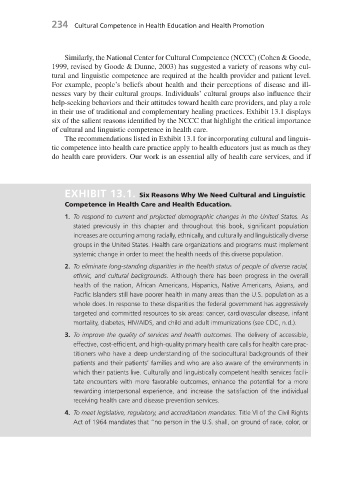
                       in their use of traditional and complementary healing practices. Exhibit  13.1  displays
                       six of the salient reasons identified by the NCCC that highlight the critical importance

                       of cultural and linguistic competence in health care.
                            The recommendations listed in Exhibit  13.1  for incorporating cultural and linguis-
                       tic competence into health care practice apply to health educators just as much as they
                       do health care providers. Our work is an essential ally of health care services, and if


                            EXHIBIT 13.1.  Six Reasons Why We Need Cultural and Linguistic
                          Competence in Health Care and Health Education.

                              1.   To respond to current and projected demographic changes in the United States.  As

                             stated previously in this chapter and throughout this book, signifi cant  population
                             increases are occurring among racially, ethnically, and culturally and linguistically diverse
                             groups in the United States. Health care organizations and programs must implement
                             systemic change in order to meet the health needs of this diverse population.


                            2.   To eliminate long - standing disparities in the health status of people of diverse racial,
                             ethnic, and cultural backgrounds.  Although there has been progress in the overall
                             health of the nation, African Americans, Hispanics, Native Americans, Asians, and
                             Pacifi c Islanders still have poorer health in many areas than the U.S. population as a
                             whole does. In response to these disparities the federal government has aggressively
                             targeted and committed resources to six areas: cancer, cardiovascular disease, infant
                             mortality, diabetes, HIV/AIDS, and child and adult immunizations (see CDC, n.d.).


                            3.   To improve the quality of services and health outcomes.  The delivery of accessible,
                             effective, cost - effi cient, and high - quality primary health care calls for health care prac-
                             titioners who have a deep understanding of the sociocultural backgrounds of their
                             patients and their patients ’  families and who are also aware of the environments in
                             which their patients live. Culturally and linguistically competent health services facili-
                             tate encounters with more favorable outcomes, enhance the potential for a more
                             rewarding interpersonal experience, and increase the satisfaction of the individual
                             receiving health care and disease prevention services.


                            4.   To meet legislative, regulatory, and accreditation mandates.  Title VI of the Civil Rights
                             Act of 1964 mandates that  “ no person in the U.S. shall, on ground of race, color, or


                                                                                                  7/1/08   3:06:11 PM
          c13.indd   234                                                                          7/1/08   3:06:11 PM
          c13.indd   234

