


Page 308 - E-Bussiness and E-Commerce Management Strategy, Implementation, and Practice
P. 308
M05_CHAF9601_04_SE_C05.QXD:D01_CHAF7409_04_SE_C01.QXD  16/4/09  11:12  Page 275


                                                                                 Chapter 5 E-business strategy  275


                                                              Market Driving  Market Driven
                                                        Capability/Incentives  and motivation  Keep pace with
                                                                                Strategy:
                                                                Strategy:
                                                          High
                                                                Customer
                                                                education
                                                                              market threats/
                                                                              opportunities
                                                                               Capability
                                                                                Building:
                                                        Internal  Low  Status Quo:  Build for transition
                                                               Don’t Bother
                                                                               to Electronic
                                                                               Commerce

                                                                  Low             High
                                                                 External Forces/Incentives

                                                   Matrix for evaluation of external capability against internal capability
                                      Figure 5.9
                                                   Source: Perrott (2005)

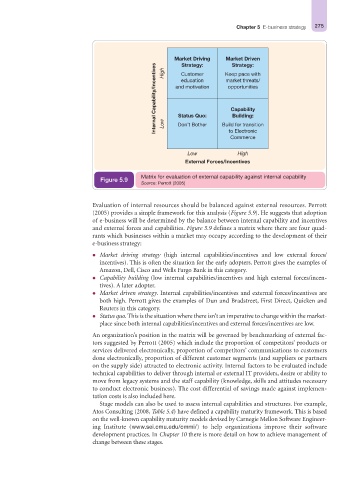
                                    Evaluation of internal resources should be balanced against external resources. Perrott
                                    (2005) provides a simple framework for this analysis (Figure 5.9). He suggests that adoption
                                    of e-business will be determined by the balance between internal capability and incentives
                                    and external forces and capabilities. Figure 5.9 defines a matrix where there are four quad-
                                    rants which businesses within a market may occupy according to the development of their
                                    e-business strategy:
                                      Market driving strategy (high internal capabilities/incentives and low external forces/
                                      incentives). This is often the situation for the early adopters. Perrott gives the examples of
                                      Amazon, Dell, Cisco and Wells Fargo Bank in this category.
                                      Capability building (low internal capabilities/incentives and high external forces/incen-
                                      tives). A later adopter.
                                      Market driven strategy. Internal capabilities/incentives and external forces/incentives are
                                      both high. Perrott gives the examples of Dun and Bradstreet, First Direct, Quicken and
                                      Reuters in this category.
                                      Status quo. This   is the situation where there isn’t an imperative to change within the market-
                                      place since both internal capabilities/incentives and external forces/incentives are low.
                                    An organization’s position in the matrix will be governed by benchmarking of external fac-
                                    tors suggested by Perrott (2005) which include the proportion of competitors’ products or
                                    services delivered electronically, proportion of competitors’ communications to customers
                                    done electronically, proportion of different customer segments (and suppliers or partners
                                    on the supply side) attracted to electronic activity. Internal factors to be evaluated include
                                    technical capabilities to deliver through internal or external IT providers, desire or ability to
                                    move from legacy systems and the staff capability (knowledge, skills and attitudes necessary
                                    to conduct electronic business). The cost differential of savings made against implemen-
                                    tation costs is also included here.
                                      Stage models can also be used to assess internal capabilities and structures. For example,
                                    Atos Consulting (2008, Table 5.4) have defined a capability maturity framework. This is based
                                    on the well-known capability maturity models devised by Carnegie Mellon Software Engineer-
                                    ing Institute (www.sei.cmu.edu/cmmi/) to help organizations improve their software
                                    development practices. In Chapter 10 there is more detail on how to achieve management of
                                    change between these stages.

