


Page 309 - E-Bussiness and E-Commerce Management Strategy, Implementation, and Practice
P. 309
M05_CHAF9601_04_SE_C05.QXD:D01_CHAF7409_04_SE_C01.QXD  16/4/09  11:12  Page 276


                276  Part 2 Strategy and applications


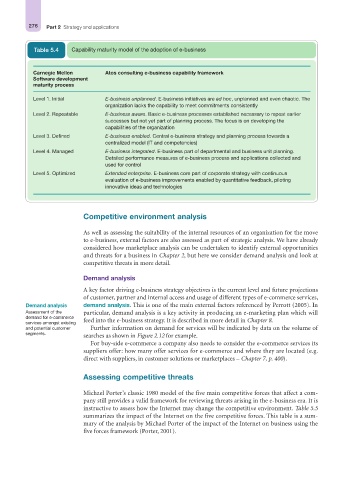
                  Table 5.4  Capability maturity model of the adoption of e-business


                 Carnegie Mellon        Atos consulting e-business capability framework
                 Software development
                 maturity process

                 Level 1. Initial       E-business unplanned. E-business initiatives are ad hoc, unplanned and even chaotic. The
                                        organization lacks the capability to meet commitments consistently
                 Level 2. Repeatable    E-business aware. Basic e-business processes established necessary to repeat earlier
                                        successes but not yet part of planning process. The focus is on developing the
                                        capabilities of the organization
                 Level 3. Defined       E-business enabled. Central e-business strategy and planning process towards a
                                        centralized model (IT and competencies)
                 Level 4. Managed       E-business integrated. E-business part of departmental and business unit planning.
                                        Detailed performance measures of e-business process and applications collected and
                                        used for control
                 Level 5. Optimized     Extended enterprise. E-business core part of corporate strategy with continuous
                                        evaluation of e-business improvements enabled by quantitative feedback, piloting
                                        innovative ideas and technologies


                                 Competitive environment analysis

                                 As well as assessing the suitability of the internal resources of an organization for the move
                                 to e-business, external factors are also assessed as part of strategic analysis. We have already
                                 considered how marketplace analysis can be undertaken to identify external opportunities
                                 and threats for a business in Chapter 2, but here we consider demand analysis and look at
                                 competitive threats in more detail.

                                 Demand analysis
                                 A key factor driving e-business strategy objectives is the current level and future projections
                                 of customer, partner and internal access and usage of different types of e-commerce services,
               Demand analysis   demand analysis. This is one of the main external factors referenced by Perrott (2005). In
               Assessment of the  particular, demand analysis is a key activity in producing an e-marketing plan which will
               demand for e-commerce
               services amongst existing  feed into the e-business strategy. It is described in more detail in Chapter 8.
               and potential customer  Further information on demand for services will be indicated by data on the volume of
               segments.
                                 searches as shown in Figure 2.12 for example.
                                   For buy-side e-commerce a company also needs to consider the e-commerce services its
                                 suppliers offer: how many offer services for e-commerce and where they are located (e.g.
                                 direct with suppliers, in customer solutions or marketplaces – Chapter 7, p. 400).

                                 Assessing competitive threats

                                 Michael Porter’s classic 1980 model of the five main competitive forces that affect a com-
                                 pany still provides a valid framework for reviewing threats arising in the e-business era. It is
                                 instructive to assess how the Internet may change the competitive environment. Table 5.5
                                 summarizes the impact of the Internet on the five competitive forces. This table is a sum-
                                 mary of the analysis by Michael Porter of the impact of the Internet on business using the
                                 five forces framework (Porter, 2001).

