


Page 489 - Flexible Robotics in Medicine
P. 489
OmniFlex: omnidirectional flexible hand-held endoscopic manipulator with spheroidal joint 483

               The active end consists of two connecting spacers (adapters) and one middle spacer along
               with the forceps and spring. Connecting spacer connects tension spring (3 mm diameter)
               and compression spring (4.5 mm diameter), and connects compression spring and forceps.
               The cables are put outside the spring to maximize the moment arm, thus increasing
               precision and ease of control. This product is designed to work with the current
               manipulator. Hence the instrumentations are like a conventional nasal endoscopic biopsy
               procedure, which may include bronchoscope, light source, image processor, etc.


               21.4 Benchmarking

               To use the OmniFlex, one must first ensure that the manipulator working diameter is large
               enough to house the OmniFlex working tube. Like how a usual biopsy operation is
               conducted, the manipulator is first inserted into the nasal cavity. The operator uses the
               distal camera to navigate to the target site before the OmniFlex is passed through the
               working channel of the manipulator. Once inserted, the OmniFlex distal tool should extend
               beyond the distal orifice of the manipulator working channel and come into view of the
               camera. The operator can then use the camera to navigate the actively controllable distal
               tool of the OmniFlex to the biopsy tissue. A single hand is required for both the actuation
               of curvature and the opening and closing of the forceps, allowing the operator to grab the
               target tissue quickly without the need for extensive hand actions.
               In many ENT procedures, the ENT specialists will encounter head and neck regions that
               contained vital organs and structures such as the brain, facial motor nerves, and sensory
               centers. This region also contains significant blood vessels and can lead to severe
               complications or even death if damaged. Therefore the ENT manipulator shall be steerable
               at the distal tip to navigate the area and avoid contact with the surrounding tissues. With the
               ease of accessibility of the parts and having a small number of parts, OmniFlex can scale-
               down in size to make it even smaller and portable. Additionally, it is compact, hand-held,
               and easy to operate. Being omnidirectional and with actively steerable forceps, OmniFlex
               can maneuver contours and anatomical curves effectively inside the nasal cavity.

               Flexible endoscopic manipulators are the ideal prototypes to use as benchmarking tools
               because the OmniFlex must complement the existing endoscopic prototypes. Therefore
               defined metrics should match or surpass the capabilities of the existing flexible endoscopic

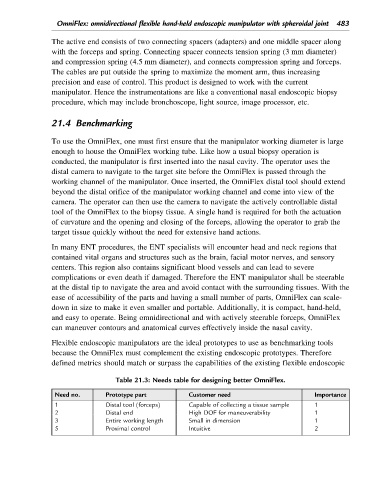
                                 Table 21.3: Needs table for designing better OmniFlex.

                Need no.      Prototype part         Customer need                      Importance
                1             Distal tool (forceps)  Capable of collecting a tissue sample  1
                2             Distal end             High DOF for maneuverability       1
                3             Entire working length  Small in dimension                 1
                5             Proximal control       Intuitive                          2

