


Page 490 - Flexible Robotics in Medicine
P. 490
484 Chapter 21
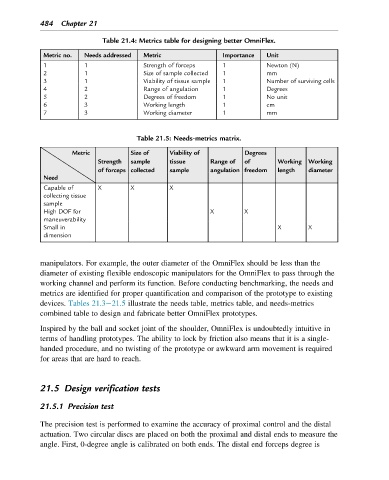
                             Table 21.4: Metrics table for designing better OmniFlex.

             Metric no.  Needs addressed  Metric               Importance  Unit
             1          1                Strength of forceps   1           Newton (N)
             2          1                Size of sample collected  1       mm
             3          1                Viability of tissue sample  1     Number of surviving cells
             4          2                Range of angulation   1           Degrees
             5          2                Degrees of freedom    1           No unit
             6          3                Working length        1           cm
             7          3                Working diameter      1           mm


                                       Table 21.5: Needs-metrics matrix.
                     Metric          Size of    Viability of         Degrees
                            Strength  sample    tissue     Range of  of       Working  Working
                            of forceps collected  sample   angulation freedom  length  diameter
             Need
             Capable of     X        X          X
             collecting tissue
             sample
             High DOF for                                  X         X
             maneuverability
             Small in                                                         X       X
             dimension


            manipulators. For example, the outer diameter of the OmniFlex should be less than the
            diameter of existing flexible endoscopic manipulators for the OmniFlex to pass through the
            working channel and perform its function. Before conducting benchmarking, the needs and
            metrics are identified for proper quantification and comparison of the prototype to existing
            devices. Tables 21.3 21.5 illustrate the needs table, metrics table, and needs-metrics
            combined table to design and fabricate better OmniFlex prototypes.
            Inspired by the ball and socket joint of the shoulder, OmniFlex is undoubtedly intuitive in
            terms of handling prototypes. The ability to lock by friction also means that it is a single-
            handed procedure, and no twisting of the prototype or awkward arm movement is required
            for areas that are hard to reach.


            21.5 Design verification tests


            21.5.1 Precision test

            The precision test is performed to examine the accuracy of proximal control and the distal
            actuation. Two circular discs are placed on both the proximal and distal ends to measure the
            angle. First, 0-degree angle is calibrated on both ends. The distal end forceps degree is

