


Page 492 - Flexible Robotics in Medicine
P. 492
486 Chapter 21

            recorded accordingly, and the level of discrepancy is calculated. The maximum angle
            difference is 180 degrees, so accuracy will be calculated by taking 180 minuses the average
            discrepancy and then take a percentage of that over 180. Fig. 21.5 presents the precision
            test setup, and Table 21.6 displays the precision test results. Table 21.6 discloses 8.57% of
            angle discrepancy, while the accuracy reached 95.23%.


            21.5.2 Bend test

            The bend test is to calibrate the payload capacity before it bends more than 10% of its
            length. The actuation length of the forceps is 6.5 cm, so the maximum height it can bend is
            0.65 cm. The weight it can hold before cross the bend limit is 13 g (Fig. 21.6). The amount
            of weight supported for the paper clips before 10% bending achieved is 0.128 N.


            21.5.3 Angle of curvature test

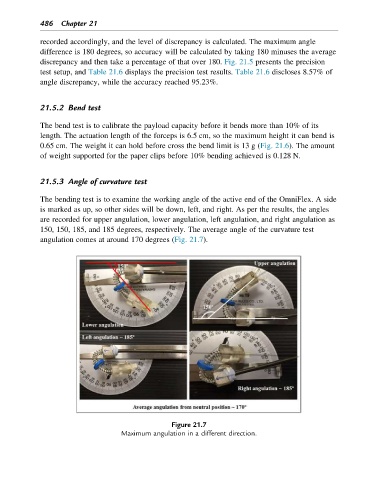
            The bending test is to examine the working angle of the active end of the OmniFlex. A side
            is marked as up, so other sides will be down, left, and right. As per the results, the angles
            are recorded for upper angulation, lower angulation, left angulation, and right angulation as
            150, 150, 185, and 185 degrees, respectively. The average angle of the curvature test
            angulation comes at around 170 degrees (Fig. 21.7).


                                                 Figure 21.7
                                   Maximum angulation in a different direction.

