


Page 311 - gas transport in porous media
P. 311
310
                           the sensing medium (like a well) or a reservoir in the sensor package, which can
                           dry out.                                                    Ho et al.
                           Cons: May not be able to discriminate among unknown mixtures of chemicals. Some
                           polymers react strongly to water vapor. Uncertain durability of polymers in subsurface
                           environments; need to develop robust packaging. May need pre-concentrator to detect
                           very low limits (for regulatory standards).Although reversible, signal may experience
                           hysteresis and a shift in the baseline when exposed to chemicals.
                           18.3.1.2 Catalytic bead sensors
                           Catalytic bead sensors are low-power devices (50–300 mW) that have been used
                           for many years in the detection of combustible gases, particularly methane in air
                           (U.S. EPA 1995). They are used widely in portable gas detection instruments. The
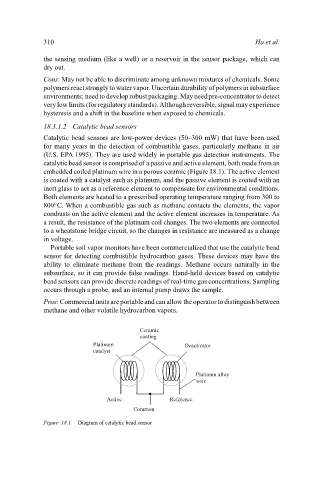
                           catalytic bead sensor is comprised of a passive and active element, both made from an
                           embedded coiled platinum wire in a porous ceramic (Figure 18.1). The active element
                           is coated with a catalyst such as platinum, and the passive element is coated with an
                           inert glass to act as a reference element to compensate for environmental conditions.
                           Both elements are heated to a prescribed operating temperature ranging from 300 to
                              ◦
                           800 C. When a combustible gas such as methane contacts the elements, the vapor
                           combusts on the active element and the active element increases in temperature. As
                           a result, the resistance of the platinum coil changes. The two elements are connected
                           to a wheatstone bridge circuit, so the changes in resistance are measured as a change
                           in voltage.
                             Portable soil vapor monitors have been commercialized that use the catalytic bead
                           sensor for detecting combustible hydrocarbon gases. These devices may have the
                           ability to eliminate methane from the readings. Methane occurs naturally in the
                           subsurface, so it can provide false readings. Hand-held devices based on catalytic
                           bead sensors can provide discrete readings of real-time gas concentrations. Sampling
                           occurs through a probe, and an internal pump draws the sample.
                           Pros: Commercial units are portable and can allow the operator to distinguish between
                           methane and other volatile hydrocarbon vapors.

                                                      Ceramic
                                                      coating
                                         Platinum                  Deactivator
                                         catalyst


                                                                      Platinum alloy
                                                                      wire


                                             Active            Reference
                                                    Common

                           Figure 18.1.  Diagram of catalytic bead sensor

