


Page 861 - Industrial Power Engineering and Applications Handbook
P. 861
Making capacitor units and ratings of switching devices  25/815
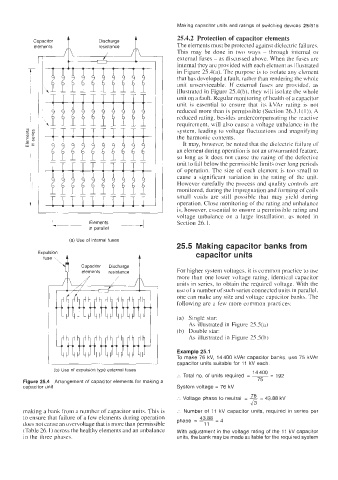
                                                       25.4.2  Protection of capacitor elements
           Capacitor           Discharge
           elements            resistance              The elements must be protected against dielectric failures.
                                                       This  may  be  done  in  two  ways  - through  internal  or
                                                       external fuses - as discussed above. When the fuses are
                                                       internal they are provided with each element as illustrated
                                                       in Figure 25.4(a). The purpose is to isolate any element
                                                       that has developed a fault, rather than rendering the whole
                                                       unit  unserviceable.  If  external  fuses  are  provided,  as
                                                       illustrated in Figure 2S.4(b), they will  isolate the whole
                                                       unit on a fault. Regular monitoring of health ofa capacitor
                                                       unit  is  essential  to  ensure  that  its  kVAr  rating  is  not
                                                       reduced more than is permissible (Section 26.3.1 ( 1 )). A
                                                       reduced rating, besides undercompensating the reactive
                                                       requirement, will  also cause a voltage unbalance in the
                                                       system, leading to voltage fluctuations and  magnifying
                                                       the harmonic contents.
                                                        It may, however, be noted that the dielectric failure of
                                                       an element during operation is not an unwarranted feature,
                                                       so long as  it does not cause the rating of the defective
                                                       unit to fall below the permissible limits over long periods
                                                       of  operation. The  size of  each element is  too  small  to
                                                       cause  a  significant variation  in  the  rating  of  the  unit.
                                                       However carefully the process  and quality controls are
                                                       monitored, during the impregnation and forming of coils
                                                       small  voids  are  still  possible  that  may  yield  during
                                                       operation. Close monitoring of the rating and unbalance
                                                       is, however, essential to ensure a permissible rating and
                 -          Elements       4           voltage  unbalance  on  a  large  installation.  as  noted  in
                                                       Section 26.1.
                 I
                            in parallel
                      (a) Use of  internal fuses
                                                       25.5  Making capacitor banks from
             Ex p  u I s i o n                              capacitor units
              fuse   4
                          Capacitor   Discharge
                          elements   resistance        For higher system voltages, it is common practice to use
                                                       more than one lower voltage rating, identical  capacitor
                                                       units  in  series, to obtain the required voltage. With the
                                                       use of a number of such series connected units in parallel,
                                                       one can make any size and voltage capacitor banks. The
                                                       following are a few more common practices:

                                                       (a)  Single star:
                                                          As illustrated in Figure 2SS(a)
                                                       (b)  Double star:
                                                          As illustrated  in Figure 2S.S(b)

                                                       Example 25.1
                                                       To  make 76 kV,  14400 kVAr capacitor  banks, use 75 kVAr
                                                       capacitor units suitable for  11 kV each.
                  (b) Use of expulsion type external fuses
                                                                              '4400  = 192
                                                       :.  Total no. of  units required  =  ~   75
        Figure 25.4  Arrangement of  capacitor elements for making a
        capacitor unit                                 System voltage  = 76 kV
                                                                             76
                                                                                =
                                                       :.  Voltage  phase to neutral  = - 43.88 kV
                                                                             43
        making a bank from a number of capacitor units. This is   :.  Number  of  11  kV  capacitor  units,  required  in series  per
                                                              43.88  -
        to ensure that failure of a few elements during operation   phase  = -
                                                                   -
        does not cause an overvoltage that is more than permissible   11
        (Table 26. I  ) across the healthy elements and an unbalance   With adjustment  in the voltage  rating of the 11 kV capacitor
        in the three phases.                           units, the bank may be made suitable for the required system

