


Page 289 - Just Promoted A 12 Month Road Map for Success in Your New Leadership Role
P. 289
274 Just Promoted!

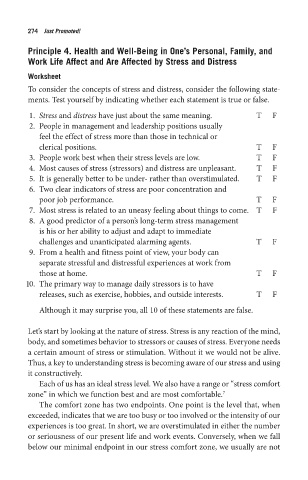
        Principle 4. Health and Well-Being in One’s Personal, Family, and
        Work Life Affect and Are Affected by Stress and Distress
        Worksheet
        To consider the concepts of stress and distress, consider the following state-
        ments. Test yourself by indicating whether each statement is true or false.

         1. Stress and distress have just about the same meaning.    T   F
         2. People in management and leadership positions usually
           feel the effect of stress more than those in technical or
           clerical positions.                                       T   F
         3. People work best when their stress levels are low.       T   F
         4. Most causes of stress (stressors) and distress are unpleasant.  T  F
         5. It is generally better to be under- rather than overstimulated.  T  F
         6. Two clear indicators of stress are poor concentration and
           poor job performance.                                     T   F
         7. Most stress is related to an uneasy feeling about things to come. T  F
         8. A good predictor of a person’s long-term stress management
           is his or her ability to adjust and adapt to immediate
           challenges and unanticipated alarming agents.             T   F
         9. From a health and fitness point of view, your body can
           separate stressful and distressful experiences at work from
           those at home.                                            T   F
        10. The primary way to manage daily stressors is to have
           releases, such as exercise, hobbies, and outside interests.  T  F

           Although it may surprise you, all 10 of these statements are false.

        Let’s start by looking at the nature of stress. Stress is any reaction of the mind,
        body, and sometimes behavior to stressors or causes of stress. Everyone needs
        a certain amount of stress or stimulation. Without it we would not be alive.
        Thus, a key to understanding stress is becoming aware of our stress and using
        it constructively.
           Each of us has an ideal stress level. We also have a range or “stress comfort
        zone” in which we function best and are most comfortable. 7
           The comfort zone has two endpoints. One point is the level that, when
        exceeded, indicates that we are too busy or too involved or the intensity of our
        experiences is too great. In short, we are overstimulated in either the number
        or seriousness of our present life and work events. Conversely, when we fall
        below our minimal endpoint in our stress comfort zone, we usually are not

