


Page 290 - Just Promoted A 12 Month Road Map for Success in Your New Leadership Role
P. 290
Creating Your New Life Integration  275

        challenged enough, we are bored, or we are involved in activities that are not
        important to us.
           When we go over the edges of our personal comfort zone, we experience dis-
        tress. Too much or too little stimulation equals distress. Contrary to stress, which
        can mobilize us and is often a useful reaction of the mind or body, distress has
        negative aspects. When we are aware of our stressors and use them well, we feel
        challenged, alert, and alive. As we approach the endpoints of our comfort zone,
        we usually begin to have different feelings. They are not necessarily bad, but they
        often act as warnings that we are not at our peak. As we slide past our comfort
        zone, from either end, many telltale symptoms begin to appear.
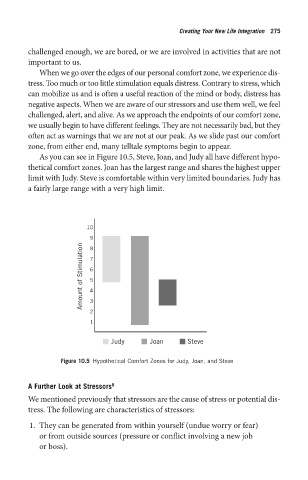
           As you can see in Figure 10.5, Steve, Joan, and Judy all have different hypo-
        thetical comfort zones. Joan has the largest range and shares the highest upper
        limit with Judy. Steve is comfortable within very limited boundaries. Judy has
        a fairly large range with a very high limit.


                        10
                         9 8
                       Amount of Stimulation  7 6 5 4


                         2 3
                         1

                               Judy      Joan      Steve


                 Figure 10.5 Hypothetical Comfort Zones for Judy, Joan, and Steve


        A Further Look at Stressors 8
        We mentioned previously that stressors are the cause of stress or potential dis-
        tress. The following are characteristics of stressors:
         1. They can be generated from within yourself (undue worry or fear)
           or from outside sources (pressure or conflict involving a new job
           or boss).

