


Page 303 - PRINCIPLES OF QUANTUM MECHANICS as Applied to Chemistry and Chemical Physics
P. 303
294 Appendix C
H(x, ε)
1
2ε/2 0 ε/2 x
H(x)
1
1
2
0 x
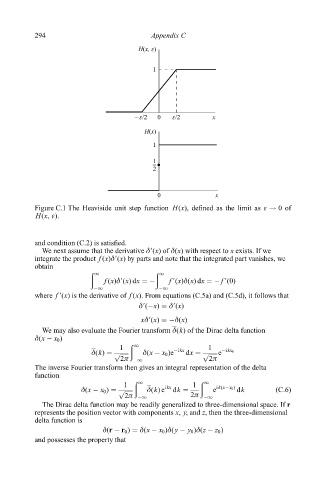
Figure C.1 The Heaviside unit step function H(x), de®ned as the limit as å ! 0of
H(x, å).
and condition (C.2) is satis®ed.
We next assume that the derivative ä9(x)of ä(x) with respect to x exists. If we
integrate the product f (x)ä9(x) by parts and note that the integrated part vanishes, we
obtain
1 1
f (x)ä9(x)dx ÿ f 9(x)ä(x)dx ÿf 9(0)
ÿ1 ÿ1
where f 9(x) is the derivative of f (x). From equations (C.5a) and (C.5d), it follows that
ä9(ÿx) ä9(x)
xä9(x) ÿä(x)
We may also evaluate the Fourier transform ä(k) of the Dirac delta function
ä(x ÿ x 0 )
1
1 1
ä(k) p ä(x ÿ x 0 )e ÿikx dx p e ÿikx 0
2ð
2ð ÿ1
The inverse Fourier transform then gives an integral representation of the delta
function
1
1 ikx 1
1 ik(xÿx 0 )
ä(x ÿ x 0 ) p ä(k)e dk e dk (C:6)
2ð
2ð ÿ1 ÿ1
The Dirac delta function may be readily generalized to three-dimensional space. If r
represents the position vector with components x, y, and z, then the three-dimensional
delta function is
ä(r ÿ r 0 ) ä(x ÿ x 0 )ä(y ÿ y 0 )ä(z ÿ z 0 )
and possesses the property that

