


Page 305 - PRINCIPLES OF QUANTUM MECHANICS as Applied to Chemistry and Chemical Physics
P. 305
Appendix D
Hermite polynomials
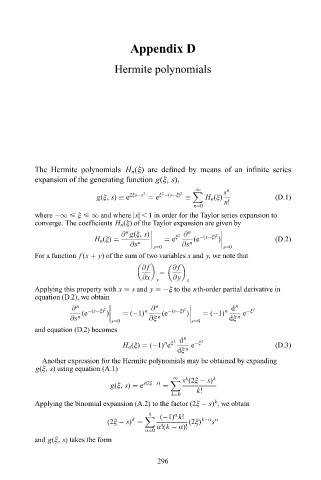
The Hermite polynomials H n (î) are de®ned by means of an in®nite series
expansion of the generating function g(î, s),
1 s n
X
2
2
2
g(î, s) e 2îsÿs e î ÿ(sÿî) H n (î) (D:1)
n!
n0
where ÿ1 < î < 1 and where jsj , 1 in order for the Taylor series expansion to
converge. The coef®cients H n (î) of the Taylor expansion are given by
n n
@ g(î, s) î 2 @ 2
)
H n (î) n e n (e ÿ(sÿî) (D:2)
@s @s
s0 s0
For a function f (x y) of the sum of two variables x and y, we note that
@ f @ f
@x y @ y x
Applying this property with x s and y ÿî to the nth-order partial derivative in
equation (D.2), we obtain
@ n 2 n @ n 2 n d n ÿî 2
)
)
(e ÿ(sÿî) (ÿ1) (e ÿ(sÿî) (ÿ1) e
@s n @î n dî n
s0 s0
and equation (D.2) becomes
n î
H n (î) (ÿ1) e 2 d n e ÿî 2 (D:3)
dî n
Another expression for the Hermite polynomials may be obtained by expanding
g(î, s) using equation (A.1)
X k k
1
s (2î ÿ s)
g(î, s) e s(2îÿs)
k!
k0
k
Applying the binomial expansion (A.2) to the factor (2î ÿ s) , we obtain
k á
X (ÿ1) k!
k kÿá á
(2î ÿ s) (2î) s
á!(k ÿ á)!
á0
and g(î, s) takes the form
296

