


Page 306 - PRINCIPLES OF QUANTUM MECHANICS as Applied to Chemistry and Chemical Physics
P. 306
Hermite polynomials 297
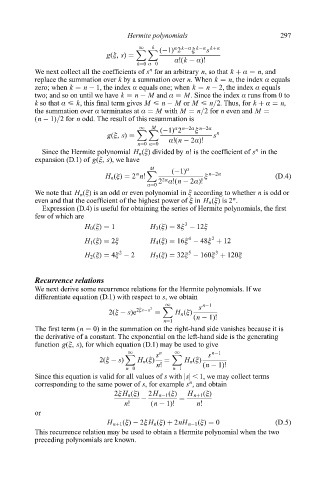
1 k á kÿá kÿá ká
X X (ÿ1) 2 î s
g(î, s)
á!(k ÿ á)!
k0 á0
n
We next collect all the coef®cients of s for an arbitrary n, so that k á n, and
replace the summation over k by a summation over n. When k n, the index á equals
zero; when k n ÿ 1, the index á equals one; when k n ÿ 2, the index á equals
two; and so on until we have k n ÿ M and á M. Since the index á runs from 0 to
k so that á < k, this ®nal term gives M < n ÿ M or M < n=2. Thus, for k á n,
the summation over á terminates at á M with M n=2 for n even and M
(n ÿ 1)=2 for n odd. The result of this resummation is
1 M á nÿ2á nÿ2á
X X (ÿ1) 2 î n
g(î, s) s
á!(n ÿ 2á)!
n0 á0
n
Since the Hermite polynomial H n (î) divided by n! is the coef®cient of s in the
expansion (D.1) of g(î, s), we have
M á
X (ÿ1) nÿ2á
n
H n (î) 2 n! î (D:4)
2á
2 á!(n ÿ 2á)!
á0
We note that H n (î) is an odd or even polynomial in î according to whether n is odd or
n
even and that the coef®cient of the highest power of î in H n (î)is 2 .
Expression (D.4) is useful for obtaining the series of Hermite polynomials, the ®rst
few of which are
3
H 0 (î) 1 H 3 (î) 8î ÿ 12î
2
4
H 1 (î) 2î H 4 (î) 16î ÿ 48î 12
2
5
3
H 2 (î) 4î ÿ 2 H 5 (î) 32î ÿ 160î 120î
Recurrence relations
We next derive some recurrence relations for the Hermite polynomials. If we
differentiate equation (D.1) with respect to s, we obtain
1 nÿ1
X s
2
2îsÿs
2(î ÿ s)e H n (î)
(n ÿ 1)!
n1
The ®rst term (n 0) in the summation on the right-hand side vanishes because it is
the derivative of a constant. The exponential on the left-hand side is the generating
function g(î, s), for which equation (D.1) may be used to give
1 n 1 nÿ1
X s X s
2(î ÿ s) H n (î) H n (î)
n! (n ÿ 1)!
n0 n1
Since this equation is valid for all values of s with jsj , 1, we may collect terms
n
corresponding to the same power of s, for example s , and obtain
2îH n (î) 2H nÿ1 (î) H n1 (î)
ÿ
n! (n ÿ 1)! n!
or
H n1 (î) ÿ 2îH n (î) 2nH nÿ1 (î) 0 (D:5)
This recurrence relation may be used to obtain a Hermite polynomial when the two
preceding polynomials are known.

