Page 308 - PRINCIPLES OF QUANTUM MECHANICS as Applied to Chemistry and Chemical Physics
P. 308
Hermite polynomials                       299

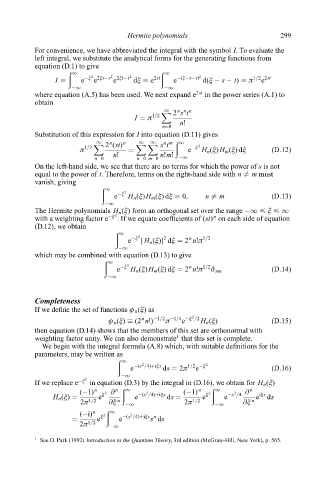
                        For convenience, we have abbreviated the integral with the symbol I. To evaluate the
                        left integral, we substitute the analytical forms for the generating functions from
                        equation (D.1) to give
                                 …                         …
                                  1    2     2    2         1         2
                                                                                       e
                             I ˆ     e ÿî  e 2îsÿs  e 2îtÿt  dî ˆ e 2st  e ÿ(îÿsÿt)  d(î ÿ s ÿ t) ˆ ð 1=2 2st
                                  ÿ1                        ÿ1
                        where equation (A.5) has been used. We next expand e 2st  in the power series (A.1) to
                        obtain
                                                            1  n n n
                                                           X  2 s t
                                                   I ˆ ð 1=2
                                                                n!
                                                           nˆ0
                        Substitution of this expression for I into equation (D.11) gives
                                         1  n   n    1  1   n m  … 1
                                        X  2 (st)   X X    s t       2
                                    ð 1=2         ˆ               e ÿî  H n (î)H m (î)dî  (D:12)
                                              n!           n!m!
                                        nˆ0         nˆ0 mˆ0     ÿ1
                        On the left-hand side, we see that there are no terms for which the power of s is not
                        equal to the power of t. Therefore, terms on the right-hand side with n 6ˆ m must
                        vanish, giving
                                          …
                                           1     2
                                              e ÿî  H n (î)H m (î)dî ˆ 0,  n 6ˆ m         (D:13)
                                           ÿ1
                        The Hermite polynomials H n (î) form an orthogonal set over the range ÿ1 < î < 1
                                              2
                                                                          n
                        with a weighting factor e ÿî  . If we equate coef®cients of (st) on each side of equation
                        (D.12), we obtain
                                              …
                                               1     2
                                                                   n
                                                            2
                                                  e ÿî  [H n (î)] dî ˆ 2 n!ð 1=2
                                               ÿ1
                        which may be combined with equation (D.13) to give
                                           …
                                            1    2
                                                                   n
                                               e ÿî  H n (î)H m (î)dî ˆ 2 n!ð 1=2 ä nm    (D:14)
                                            ÿ1
                        Completeness
                        If we de®ne the set of functions ö n (î)as
                                                                    2
                                                     n
                                                            ð
                                                                 e
                                            ö n (î)   (2 n!) ÿ1=2 ÿ1=4 ÿî =2  H n (î)     (D:15)
                        then equation (D.14) shows that the members of this set are orthonormal with
                                                               1
                        weighting factor unity. We can also demonstrate that this set is complete.
                          We begin with the integral formula (A.8) which, with suitable de®nitions for the
                        parameters, may be written as
                                               …
                                                1     2                2
                                                  e ÿ(s =4)‡iîs  ds ˆ 2ð 1=2 ÿî           (D:16)
                                                                     e
                                                ÿ1
                        If we replace e ÿî 2  in equation (D.3) by the integral in (D.16), we obtain for H n (î)
                                    (ÿ1) n  î 2 @  n  …  1  ÿ(s =4)‡iîs  (ÿ1) n  î 2  … 1  ÿs =4  @  n  iîs
                                                       2
                                                                               2
                             H n (î) ˆ   e         e         ds ˆ     e      e       e   ds
                                    2ð 1=2  @î  n                2ð 1=2           @î n
                                                 ÿ1                       ÿ1
                                    (ÿi) n  î  2  …  1  ÿ(s =4)‡iîs n
                                                  2
                                  ˆ      e     e        s ds
                                    2ð 1=2  ÿ1
                        1  See D. Park (1992) Introduction to the Quantum Theory, 3rd edition (McGraw-Hill, New York), p. 565.
   303   304   305   306   307   308   309   310   311   312   313