Page 310 - PRINCIPLES OF QUANTUM MECHANICS as Applied to Chemistry and Chemical Physics
P. 310
Appendix E

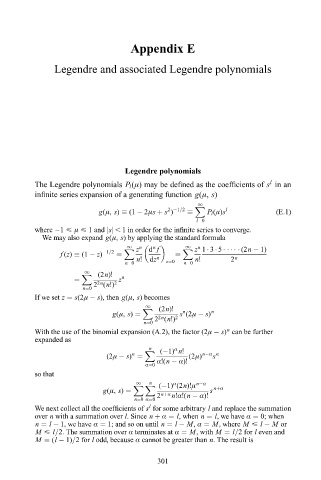
                             Legendre and associated Legendre polynomials


                                                 Legendre polynomials
                                                                                         l
                        The Legendre polynomials P l (ì) may be de®ned as the coef®cients of s in an
                        in®nite series expansion of a generating function g(ì, s)
                                                                     1
                                                                    X        l
                                                             2 ÿ1=2
                                          g(ì, s)   (1 ÿ 2ìs ‡ s )      P l (ì)s           (E:1)
                                                                     lˆ0
                        where ÿ1 < ì < 1 and jsj , 1 in order for the in®nite series to converge.
                          We may also expand g(ì, s) by applying the standard formula

                                                                  1
                                                         n
                                                 X n   d f       X n : : :      :
                                                 1
                                                                    z 1 3 5     (2n ÿ 1)
                                                    z
                               f (z)   (1 ÿ z) ÿ1=2  ˆ         ˆ
                                                    n!  dz n        n!        2 n
                                                 nˆ0        zˆ0  nˆ0
                                     1
                                     X   (2n)!  n
                                   ˆ           z
                                         2n
                                        2 (n!) 2
                                     nˆ0
                        If we set z ˆ s(2ì ÿ s), then g(ì, s) becomes
                                                       1
                                                      X   (2n)!
                                                                 n
                                             g(ì, s) ˆ          s (2ì ÿ s) n
                                                          2n
                                                         2 (n!) 2
                                                      nˆ0
                                                                             n
                        With the use of the binomial expansion (A.2), the factor (2ì ÿ s) can be further
                        expanded as
                                                        n      á
                                                      X    (ÿ1) n!
                                                   n                  nÿá á
                                            (2ì ÿ s) ˆ             (2ì)  s
                                                          á!(n ÿ á)!
                                                      áˆ0
                        so that
                                                    1   n     á      nÿá
                                                   X X    (ÿ1) (2n)!ì
                                           g(ì, s) ˆ                     s n‡á
                                                          2 n‡á n!á!(n ÿ á)!
                                                   nˆ0 áˆ0
                                                        l
                        We next collect all the coef®cients of s for some arbitrary l and replace the summation
                        over n with a summation over l. Since n ‡ á ˆ l, when n ˆ l,we have á ˆ 0; when
                        n ˆ l ÿ 1, we have á ˆ 1; and so on until n ˆ l ÿ M, á ˆ M, where M < l ÿ M or
                        M < l=2. The summation over á terminates at á ˆ M,with M ˆ l=2 for l even and
                        M ˆ (l ÿ 1)=2 for l odd, because á cannot be greater than n. The result is
                                                          301
   305   306   307   308   309   310   311   312   313   314   315