


Page 312 - PRINCIPLES OF QUANTUM MECHANICS as Applied to Chemistry and Chemical Physics
P. 312
Legendre and associated Legendre polynomials 303
@ g @ g
s (ì ÿ s)
@s @ì
so that
1 1
X l X dP l l
lP l (ì)s (ì ÿ s) s
dì
l1 l0
l
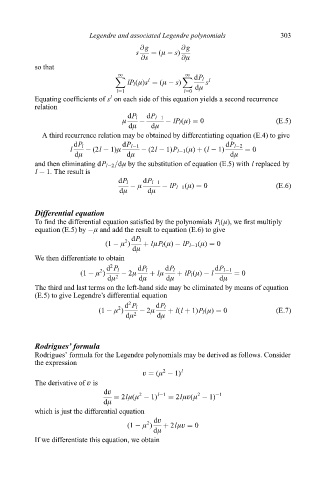
Equating coef®cients of s on each side of this equation yields a second recurrence
relation
ì dP l ÿ dP lÿ1 ÿ lP l (ì) 0 (E:5)
dì dì
A third recurrence relation may be obtained by differentiating equation (E.4) to give
dP l dP lÿ1 dP lÿ2
l ÿ (2l ÿ 1)ì ÿ (2l ÿ 1)P lÿ1 (ì) (l ÿ 1) 0
dì dì dì
and then eliminating dP lÿ2 =dì by the substitution of equation (E.5) with l replaced by
l ÿ 1. The result is
dP l ÿ ì dP lÿ1 ÿ lP lÿ1 (ì) 0 (E:6)
dì dì
Differential equation
To ®nd the differential equation satis®ed by the polynomials P l (ì), we ®rst multiply
equation (E.5) by ÿì and add the result to equation (E.6) to give
2
(1 ÿ ì ) dP l lìP l (ì) ÿ lP lÿ1 (ì) 0
dì
We then differentiate to obtain
2
2
(1 ÿ ì ) d P l ÿ 2ì dP l lì dP l lP l (ì) ÿ l dP lÿ1 0
dì 2 dì dì dì
The third and last terms on the left-hand side may be eliminated by means of equation
(E.5) to give Legendre's differential equation
2 dP l
d P l
2
(1 ÿ ì ) ÿ 2ì l(l 1)P l (ì) 0 (E:7)
dì 2 dì
Rodrigues' formula
Rodrigues' formula for the Legendre polynomials may be derived as follows. Consider
the expression
2
v (ì ÿ 1) l
The derivative of v is
dv 2 lÿ1 2 ÿ1
dì 2lì(ì ÿ 1) 2lìv(ì ÿ 1)
which is just the differential equation
dv
2
(1 ÿ ì ) 2lìv 0
dì
If we differentiate this equation, we obtain

