


Page 328 - Physical chemistry understanding our chemical world
P. 328
INTRODUCTION TO CELLS: TERMINOLOGY AND BACKGROUND        295


                          Potential/V                Current drawn/A


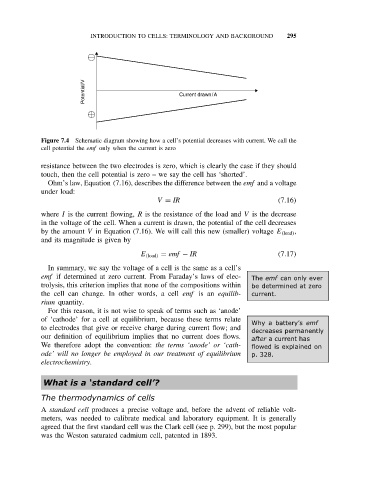
             Figure 7.4 Schematic diagram showing how a cell’s potential decreases with current. We call the
             cell potential the emf only when the current is zero


             resistance between the two electrodes is zero, which is clearly the case if they should
             touch, then the cell potential is zero – we say the cell has ‘shorted’.
               Ohm’s law, Equation (7.16), describes the difference between the emf and a voltage
             under load:
                                               V = IR                             (7.16)
             where I is the current flowing, R is the resistance of the load and V is the decrease
             in the voltage of the cell. When a current is drawn, the potential of the cell decreases
             by the amount V in Equation (7.16). We will call this new (smaller) voltage E (load) ,
             and its magnitude is given by

                                          E (load) = emf − IR                     (7.17)
               In summary, we say the voltage of a cell is the same as a cell’s
             emf if determined at zero current. From Faraday’s laws of elec-  The emf can only ever
             trolysis, this criterion implies that none of the compositions within  be determined at zero
             the cell can change. In other words, a cell emf is an equilib-  current.
             rium quantity.
               For this reason, it is not wise to speak of terms such as ‘anode’
             of ‘cathode’ for a cell at equilibrium, because these terms relate  Why a battery’s emf
             to electrodes that give or receive charge during current flow; and
                                                                          decreases permanently
             our definition of equilibrium implies that no current does flows.
                                                                          after a current has
             We therefore adopt the convention: the terms ‘anode’ or ‘cath-  flowed is explained on
             ode’ will no longer be employed in our treatment of equilibrium  p. 328.
             electrochemistry.


              What is a ‘standard cell’?
             The thermodynamics of cells

             A standard cell produces a precise voltage and, before the advent of reliable volt-
             meters, was needed to calibrate medical and laboratory equipment. It is generally
             agreed that the first standard cell was the Clark cell (see p. 299), but the most popular
             was the Weston saturated cadmium cell, patented in 1893.

