


Page 202 - Plant design and economics for chemical engineers
P. 202
176  PLANT  DESIGN  AND  ECONOMICS  FOR  CHEMICAL  ENGINEERS

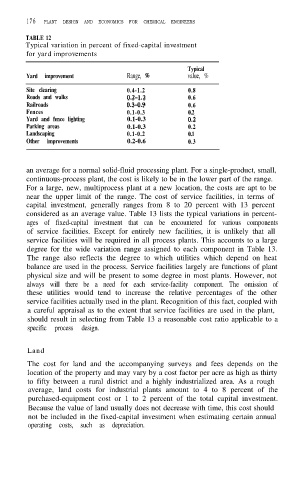
        TABLE 12
        Typical variation in percent of fixed-capital investment
        for yard improvements

                                                    Typical
        Yard  improvement           Range,  %       value, %

        Site clearing               0.4-1.2         0.8
        Roads and walks             0.2-1.2         0.6
        Railroads                   0.3-0.9         0.6
        Fences                      0.1-0.3         0.2
        Yard and fence lighting     0.1-0.3         0.2
        Parking areas               0.1-0.3         0.2
        Landscaping                 0.1-0.2         0.1
        Other  improvements         0.2-0.6         0.3


        an average for a normal solid-fluid processing plant. For a single-product, small,
        continuous-process plant, the cost is likely to be in the lower part of the range.
        For a large, new, multiprocess plant at a new location, the costs are apt to be
        near the upper limit of the range. The cost of service facilities, in terms of
        capital investment, generally ranges from 8 to 20 percent with 13 percent
        considered as an average value. Table 13 lists the typical variations in percent-
        ages of fixed-capital investment that can be encountered for various components
        of service facilities. Except for entirely new facilities, it is unlikely that all
        service facilities will be required in all process plants. This accounts to a large
        degree for the wide variation range assigned to each component in Table 13.
        The range also reflects the degree to which utilities which depend on heat
        balance are used in the process. Service facilities largely are functions of plant
        physical size and will be present to some degree in most plants. However, not
        always will there be a need for each service-facility component. The omission of
        these utilities would tend to increase the relative percentages of the other
        service facilities actually used in the plant. Recognition of this fact, coupled with
         a careful appraisal as to the extent that service facilities are used in the plant,
         should result in selecting from Table 13 a reasonable cost ratio applicable to a
         specific  process  design.


         Land
         The cost for land and the accompanying surveys and fees depends on the
         location of the property and may vary by a cost factor per acre as high as thirty
         to fifty between a rural district and a highly industrialized area. As a rough
         average, land costs for industrial plants amount to 4 to 8 percent of the
         purchased-equipment cost or 1 to 2 percent of the total capital investment.
         Because the value of land usually does not decrease with time, this cost should
         not be included in the fixed-capital investment when estimating certain annual
         operating costs, such as depreciation.

