


Page 203 - Plant design and economics for chemical engineers
P. 203
COST  ESTIMATION  177
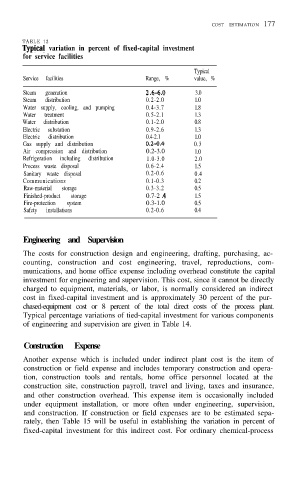
       TABLE 13
       Q-pica1  variation in percent of fixed-capital investment
       for service facilities
                                                      Typical
       Service  facilities               Range, %     value, %
       Steam  generation                 2.6-6.0      3.0
       Steam  distribution               0.2-2.0      1.0
       Water supply, cooling, and pumping  0.4-3.7    1.8
       Water  treatment                  0.5-2.1      1.3
       Water  distribution               0.1-2.0      0.8
       Electric  substation              0.9-2.6      1.3
       Electric  distribution            0.4-2.1      1.0
       Gas supply and distribution       0.2-0.4      0.3
       Air compression and distribution  0.2-3.0      1.0
       Refrigeration  including  distribution  1.0-3.0  2.0
       Process waste disposal            0.6-2.4      1.5
       Sanitary waste disposal           0.2-0.6      0.4
       Communications                    0.1-0.3      0.2
       Raw-material  storage             0.3-3.2      0.5
       Finished-product  storage         0.7-2 .4     1.5
       Fire-protection  system           0.3-1.0      0.5
       Safety  installations             0.2-0.6      0.4


       Engineering  and  Supervision
       The costs for construction design and engineering, drafting, purchasing, ac-
       counting, construction and cost engineering, travel, reproductions, com-
       munications, and home office expense including overhead constitute the capital
       investment for engineering and supervision. This cost, since it cannot be directly
       charged to equipment, materials, or labor, is normally considered an indirect
       cost in fixed-capital investment and is approximately 30 percent of the pur-
       chased-equipment cost or 8 percent of the total direct costs of the process plant.
       Typical percentage variations of tied-capital investment for various components
       of engineering and supervision are given in Table 14.


       Construction  Expense
       Another expense which is included under indirect plant cost is the item of
       construction or field expense and includes temporary construction and opera-
       tion, construction tools and rentals, home office personnel located at the
       construction site, construction payroll, travel and living, taxes and insurance,
       and other construction overhead. This expense item is occasionally included
       under equipment installation, or more often under engineering, supervision,
       and construction. If construction or field expenses are to be estimated sepa-
       rately, then Table 15 will be useful in establishing the variation in percent of
       fixed-capital investment for this indirect cost. For ordinary chemical-process

