


Page 343 - Thermal Hydraulics Aspects of Liquid Metal Cooled Nuclear Reactors
P. 343
312                   Thermal Hydraulics Aspects of Liquid Metal Cooled Nuclear Reactors


                                              Assembly
                                                duct

                                                                Fuel rod
                                                                and wire

                                                W        H


                   Interior
                 subchannel  P                Corner
                                            subchannel
                                   Edge
                                 subchannel

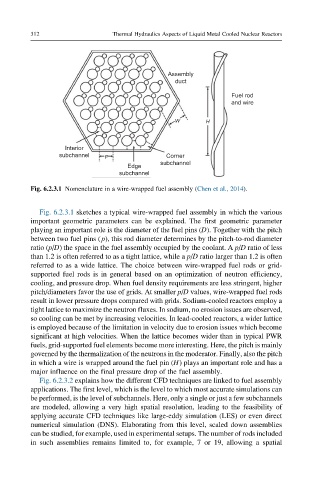
         Fig. 6.2.3.1 Nomenclature in a wire-wrapped fuel assembly (Chen et al., 2014).

            Fig. 6.2.3.1 sketches a typical wire-wrapped fuel assembly in which the various
         important geometric parameters can be explained. The first geometric parameter
         playing an important role is the diameter of the fuel pins (D). Together with the pitch
         between two fuel pins (p), this rod diameter determines by the pitch-to-rod diameter
         ratio (p/D) the space in the fuel assembly occupied by the coolant. A p/D ratio of less
         than 1.2 is often referred to as a tight lattice, while a p/D ratio larger than 1.2 is often
         referred to as a wide lattice. The choice between wire-wrapped fuel rods or grid-
         supported fuel rods is in general based on an optimization of neutron efficiency,
         cooling, and pressure drop. When fuel density requirements are less stringent, higher
         pitch/diameters favor the use of grids. At smaller p/D values, wire-wrapped fuel rods
         result in lower pressure drops compared with grids. Sodium-cooled reactors employ a
         tight lattice to maximize the neutron fluxes. In sodium, no erosion issues are observed,
         so cooling can be met by increasing velocities. In lead-cooled reactors, a wider lattice
         is employed because of the limitation in velocity due to erosion issues which become
         significant at high velocities. When the lattice becomes wider than in typical PWR
         fuels, grid-supported fuel elements become more interesting. Here, the pitch is mainly
         governed by the thermalization of the neutrons in the moderator. Finally, also the pitch
         in which a wire is wrapped around the fuel pin (H) plays an important role and has a
         major influence on the final pressure drop of the fuel assembly.
            Fig. 6.2.3.2 explains how the different CFD techniques are linked to fuel assembly
         applications. The first level, which is the level to which most accurate simulations can
         be performed, is the level of subchannels. Here, only a single or just a few subchannels
         are modeled, allowing a very high spatial resolution, leading to the feasibility of
         applying accurate CFD techniques like large-eddy simulation (LES) or even direct
         numerical simulation (DNS). Elaborating from this level, scaled down assemblies
         can be studied, for example, used in experimental setups. The number of rods included
         in such assemblies remains limited to, for example, 7 or 19, allowing a spatial

