


Page 344 - Thermal Hydraulics Aspects of Liquid Metal Cooled Nuclear Reactors
P. 344
Core thermal hydraulics                                           313


                                              Model                 Idealized conditions

                          DNS                                       Sub
                                                                   channel
                                                                    level
                          LES


                                               Physics  Computational power
                         RANS                                    Fuel assembly
                                                                    level
                     Reduced resolution
                         RANS
                                                                    Core
                       Low resolution                               level
                          CFD
                      CFD approaches          Resolve                Reactor conditions

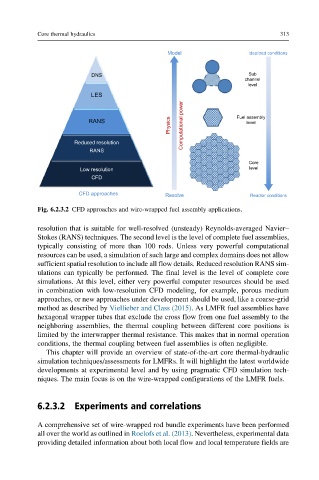
           Fig. 6.2.3.2 CFD approaches and wire-wrapped fuel assembly applications.

           resolution that is suitable for well-resolved (unsteady) Reynolds-averaged Navier–
           Stokes (RANS) techniques. The second level is the level of complete fuel assemblies,
           typically consisting of more than 100 rods. Unless very powerful computational
           resources can be used, a simulation of such large and complex domains does not allow
           sufficient spatial resolution to include all flow details. Reduced resolution RANS sim-
           ulations can typically be performed. The final level is the level of complete core
           simulations. At this level, either very powerful computer resources should be used
           in combination with low-resolution CFD modeling, for example, porous medium
           approaches, or new approaches under development should be used, like a coarse-grid
           method as described by Viellieber and Class (2015). As LMFR fuel assemblies have
           hexagonal wrapper tubes that exclude the cross flow from one fuel assembly to the
           neighboring assemblies, the thermal coupling between different core positions is
           limited by the interwrapper thermal resistance. This makes that in normal operation
           conditions, the thermal coupling between fuel assemblies is often negligible.
              This chapter will provide an overview of state-of-the-art core thermal-hydraulic
           simulation techniques/assessments for LMFRs. It will highlight the latest worldwide
           developments at experimental level and by using pragmatic CFD simulation tech-
           niques. The main focus is on the wire-wrapped configurations of the LMFR fuels.


           6.2.3.2   Experiments and correlations

           A comprehensive set of wire-wrapped rod bundle experiments have been performed
           all over the world as outlined in Roelofs et al. (2013). Nevertheless, experimental data
           providing detailed information about both local flow and local temperature fields are

