


Page 345 - Thermal Hydraulics Aspects of Liquid Metal Cooled Nuclear Reactors
P. 345
314                   Thermal Hydraulics Aspects of Liquid Metal Cooled Nuclear Reactors

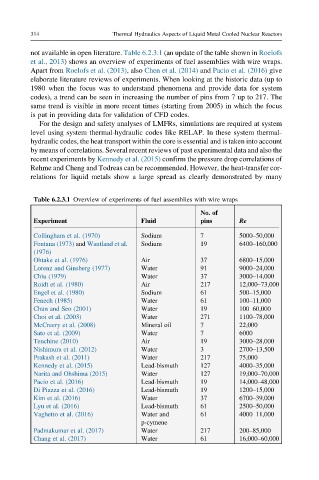
         not available in open literature. Table 6.2.3.1 (an update of the table shown in Roelofs
         et al., 2013) shows an overview of experiments of fuel assemblies with wire wraps.
         Apart from Roelofs et al. (2013), also Chen et al. (2014) and Pacio et al. (2016) give
         elaborate literature reviews of experiments. When looking at the historic data (up to
         1980 when the focus was to understand phenomena and provide data for system
         codes), a trend can be seen in increasing the number of pins from 7 up to 217. The
         same trend is visible in more recent times (starting from 2005) in which the focus
         is put in providing data for validation of CFD codes.
            For the design and safety analyses of LMFRs, simulations are required at system
         level using system thermal-hydraulic codes like RELAP. In these system thermal-
         hydraulic codes, the heat transport within the core is essential and is taken into account
         by means of correlations. Several recent reviews of past experimental data and also the
         recent experiments by Kennedy et al. (2015) confirm the pressure drop correlations of
         Rehme and Cheng and Todreas can be recommended. However, the heat-transfer cor-
         relations for liquid metals show a large spread as clearly demonstrated by many


          Table 6.2.3.1 Overview of experiments of fuel assemblies with wire wraps

                                                       No. of
                                                                  Re
          Experiment                   Fluid           pins
          Collingham et al. (1970)     Sodium          7          5000–50,000
          Fontana (1973) and Wantland et al.  Sodium   19         6400–160,000
          (1976)
          Ohtake et al. (1976)         Air             37         6800–15,000
          Lorenz and Ginsberg (1977)   Water           91         9000–24,000
          Chiu (1979)                  Water           37         3000–14,000
          Roidt et al. (1980)          Air             217        12,000–73,000
          Engel et al. (1980)          Sodium          61         500–15,000
          Fenech (1985)                Water           61         100–11,000
          Chun and Seo (2001)          Water           19         100–60,000
          Choi et al. (2003)           Water           271        1100–78,000
          McCreery et al. (2008)       Mineral oil     7          22,000
          Sato et al. (2009)           Water           7          6000
          Tenchine (2010)              Air             19         3000–28,000
          Nishimura et al. (2012)      Water           3          2700–13,500
          Prakash et al. (2011)        Water           217        75,000
          Kennedy et al. (2015)        Lead-bismuth    127        4000–35,000
          Narita and Ohshima (2015)    Water           127        19,000–70,000
          Pacio et al. (2016)          Lead-bismuth    19         14,000–48,000
          Di Piazza et al. (2016)      Lead-bismuth    19         1200–15,000
          Kim et al. (2016)            Water           37         6700–39,000
          Lyu et al. (2016)            Lead-bismuth    61         2500–50,000
          Vaghetto et al. (2016)       Water and       61         4000–11,000
                                       p-cymene
          Padmakumar et al. (2017)     Water           217        200–85,000
          Chang et al. (2017)          Water           61         16,000–60,000

