


Page 206 - Materials Chemistry, Second Edition
P. 206
Vadose Zone Soil Remediation                                     189


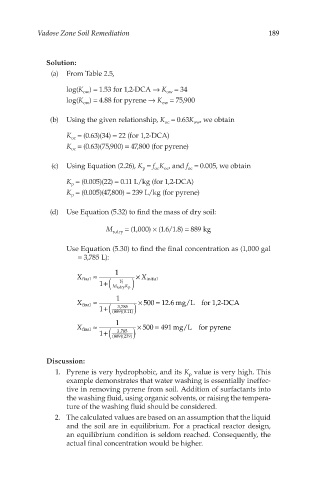
              Solution:
               (a)  From Table 2.5,

                   log(K ) = 1.53 for 1,2-DCA → K  = 34
                                               ow
                        ow
                   log(K ) = 4.88 for pyrene → K  = 75,900
                                              ow
                        ow
               (b)  Using the given relationship, K  = 0.63K , we obtain
                                                       ow
                                               oc
                   K  = (0.63)(34) = 22 (for 1,2-DCA)
                     oc
                   K  = (0.63)(75,900) = 47,800 (for pyrene)
                     oc
               (c)  Using Equation (2.26), K  = f K , and f  = 0.005, we obtain
                                                     oc
                                         p
                                               oc
                                            oc
                   K  = (0.005)(22) = 0.11 L/kg (for 1,2-DCA)
                     p
                   K  = (0.005)(47,800) = 239 L/kg (for pyrene)
                     p
               (d)  Use Equation (5.32) to find the mass of dry soil:
                               M s,dry  = (1,000) × (1.6/1.8) = 889 kg

                   Use Equation (5.30) to find the final concentration as (1,000 gal
                       = 3,785 L):
                                 1
                      X final ≈        ×  X initial
                             1 ( M s,dryp)
                              +
                                  V l
                                    K
                                 1
                      X final ≈        × 500 =  12.6 mg/L for 1,2-DCA
                             1 ( (889)(0.11))
                                  3,785
                              +
                                 1
                      X final ≈ 1 ( (889)(239)) × 500 =  491 mg/L forpyrene
                                  3,785
                              +
              Discussion:
                1.  Pyrene is very hydrophobic, and its K  value is very high. This
                                                      p
                   example demonstrates that water washing is essentially ineffec-
                   tive in removing pyrene from soil. Addition of surfactants into
                   the washing fluid, using organic solvents, or raising the tempera-
                   ture of the washing fluid should be considered.
                2.  The calculated values are based on an assumption that the liquid
                   and the soil are in equilibrium. For a practical reactor design,
                   an equilibrium condition is seldom reached. Consequently, the
                   actual final concentration would be higher.

