


Page 123 - A First Course In Stochastic Models
P. 123
COMPUTATION OF THE EQUILIBRIUM PROBABILITIES         115

                  To analyse this queueing model, define the random variable X n by

                     X n = the number of messages in the buffer (excluding any message
                          in transmission) just prior to clock time t = n.

                Then {X n , n = 0, 1, . . . } is a discrete-time Markov chain with the infinite state
                space I = {0, 1, . . . }. The one-step transition probabilities are given by

                                λ j
                              −λ
                        p ij = e  ,  0 ≤ i < c and j = 0, 1, . . .
                                j!
                                  λ j−i+c
                              −λ
                        p ij = e          ,  i ≥ c and j = i − c, i − c + 1, . . . .
                                (j − i + c)!
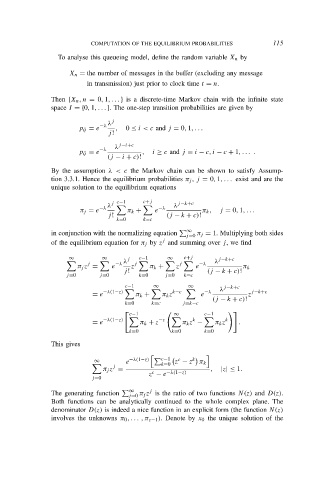
                By the assumption λ < c the Markov chain can be shown to satisfy Assump-
                tion 3.3.1. Hence the equilibrium probabilities π j , j = 0, 1, . . . exist and are the
                unique solution to the equilibrium equations

                                 j c−1    c+j       j−k+c
                                λ                  λ
                              −λ               −λ
                        π j = e       π k +   e            π k ,  j = 0, 1, . . .
                                j!               (j − k + c)!
                                   k=0    k=c
                                                       ∞
                in conjunction with the normalizing equation
 j=0 j = 1. Multiplying both sides
                                                          π
                                                j
                of the equilibrium equation for π j by z and summing over j, we find
                     ∞        ∞       j  c−1     ∞    c+j       j−k+c
                                     λ                         λ
                          j       −λ    j            j    −λ
                       π j z =   e     z    π k +   z    e             π k
                                     j!                      (j − k + c)!
                    j=0       j=0        k=0     j=0  k=c
                                     c−1     ∞         ∞        λ j−k+c
                            = e −λ(1−z)     π k +     π k z k−c     e −λ  z j−k+c
                                                              (j − k + c)!
                                     k=0     k=c      j=k−c
                                      c−1          ∞        c−1

                               −λ(1−z)         −c        k        k
                            = e          π k + z      π k z −  π k z  .
                                      k=0          k=0      k=0
                This gives

                                                    c
                            ∞        e −λ(1−z)
 c−1  z − z k
                                                k=0        π k
                                  j
                               π j z =       c   −λ(1−z)      ,  |z| ≤ 1.
                                            z − e
                           j=0

 ∞     j
                The generating function  j=0 j z is the ratio of two functions N(z) and D(z).
                                         π
                Both functions can be analytically continued to the whole complex plane. The
                denominator D(z) is indeed a nice function in an explicit form (the function N(z)
                involves the unknowns π 0 , . . . , π c−1 ). Denote by x 0 the unique solution of the

