


Page 167 - ARM 64 Bit Assembly Language
P. 167
Structured programming 153


                         16     printf("Enter x: ");
                         17     goodval = scanf("%d", &x);
                         18     if(goodval == 1)
                         19       printf("%d! = %lu\n", x, factorial(x));
                         20   } while(goodval == 1);
                         21   return 0;
                         22  }
                           Write this program in AArch64 assembly.
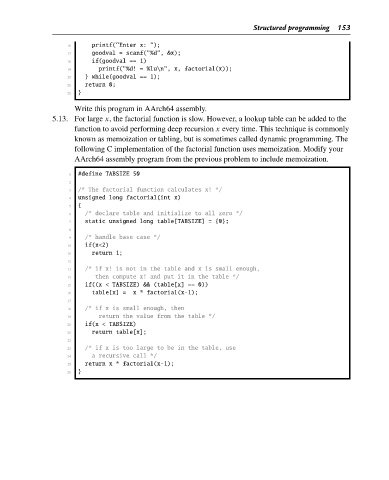
                     5.13. For large x, the factorial function is slow. However, a lookup table can be added to the
                           function to avoid performing deep recursion x every time. This technique is commonly
                           known as memoization or tabling, but is sometimes called dynamic programming. The
                           following C implementation of the factorial function uses memoization. Modify your
                           AArch64 assembly program from the previous problem to include memoization.

                          1  #define TABSIZE 50
                          2
                          3  /* The factorial function calculates x! */
                          4  unsigned long factorial(int x)
                          5  {
                          6   /* declare table and initialize to all zero */
                          7   static unsigned long table[TABSIZE] = {0};
                          8
                          9   /* handle base case */
                         10   if(x<2)
                         11     return 1;
                         12
                         13   /* if x! is not in the table and x is small enough,
                         14      then compute x! and put it in the table */
                         15   if((x < TABSIZE) && (table[x] == 0))
                         16     table[x] =  x * factorial(x-1);
                         17
                         18   /* if x is small enough, then
                         19       return the value from the table */
                         20   if(x < TABSIZE)
                         21     return table[x];
                         22
                         23   /* if x is too large to be in the table, use
                         24     a recursive call */
                         25   return x * factorial(x-1);
                         26  }

