


Page 398 - Adsorption by Powders and Porous Solids
P. 398
CHAPTER 11. ADSORPTION BY CLAYS, PILCs AND ZEOLITES             387

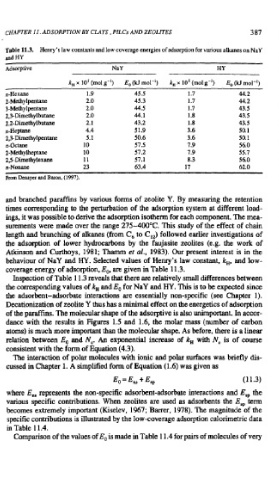
   Table 11.3.  Henry's law constants and low coverage energies of adsorption for various alkanes on Nay
   and HY
   -
   Adsorptive                  Nay                        HY
                                              k,  x  10' (mol g -')   E,, (kJ mol-')
   n-Hexane                                       1.7           44.2
   2-Methy lpentane                               1.7           44.2
   3-Methy lpentane                               1 -7          43.5
   2.3-Dimethylbutane                             1.8           43.5
   2.2-Dimethylbutane                             1.8           43.5
   n-Heptane                                      3.6           50.1
   2,3Dimethylpentane                             3.6           50.1
   n-Octane                                       7.9           56.0
   2-Methylheptane                                7.9           55.7
   2  J-Diethylexane                              8.3           56.0
   n-Nonane                                       17            62.0
   Fm Denaycr and Baron, (1997).

   md branched paraffins by  various forms of zeolite Y. By  measuring the retention
   times corresponding to the perturbation of the adsorption system at different load-
   ings, it yas possible to derive the adsorption isotherm for each component. The mea-
   surements were made over the range 275-400°C.  This study of the effect of chain
   length and branching of alkanes (from C, to C,,)  followed earlier investigations of
   the adsorption of  lower hydrocarbons  by  the faujasite zeolites (e.g.  the work  of
   Atkinson and Curthoys, 1981; Tharnrn et al., 1983). Our present interest is in the
   behaviour of Nay and HY. Selected values of Henry's law constant, k,,  and low-
   coverage energy of adsorption, E,,  are given in Table 11.3.
     Inspection of Table 1 1.3 reveals that there are relatively small differences between
   the corresponding values of kH and E, for Nay and HY. This is to be expected since
   the adsorbent-adsorbate  interactions are essentially non-specific (see Chapter  1).
   Decationization of zeolite  Y thus has a minimal effect on the energetics of adsorption
   of the paraffins. The molecular shape of the adsorptive is also unimportant. In accor-
   dance with the results in Figures 1.5 and 1.6,  the molar mass (number of carbon
   atoms) is much more important than the molecular shape. As before, there is a linear
   relation between E,  and N,. An  exponential increase of  k,  with N, is of  course
   consistent with the form of Equation (4.3).
     The interaction of polar molecules with ionic and polar surfaces was briefly dis-
   cussed in Chapter 1. A simplified form of Equation (1.6) was given as


   where En, represents the non-specific adsorbent-adsorbate interactions and E,,  the
   various specific contributions. When zeolites are used as adsorbents the E,  tern
   becomes exuemely important (Kiselev.  1967; Barrer, 1978). The magnitude of the
   specific contributions is illustrated by the low-coverage adsorption calorimetric data
   in Table 1 1.4.
     Comparison of the values of E, is made in Table 1 1.4 for pairs of molecules of very

