


Page 442 - Adsorption by Powders and Porous Solids
P. 442
ADSORPTION  BY POWDERS AND POROUS SOLJDS


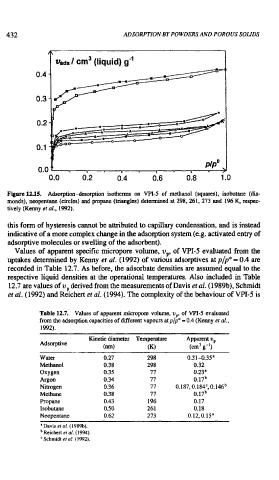
   Figure 12.15.  Adsorption-desorption isotherms  on  VPI-5  of  methanol  (squares),  isobutane  (dia-
   monds), neopentane (circles) and propane (triangles) detennined at 298, 261, 273 and  196 K.  respec-
   tively (Kenny et al.. 1992).
   this form of hysteresis cannot be attributed to capillary condensation, and is instead
   indicative of a more complex change in the adsorption system (e.g. activated entry of
   adsorptive molecules or swelling of the adsorbent).
     Values of apparent specific micropore volume, v,,  of VPI-5 evaluated from the
   uptakes determined by Kenny et al. (1992) of various adsorptives at p/pO = 0.4 are
   recorded in Table 12.7. As before, the adsorbate densities are assumed equal to the
   respective liquid densities at the operational temperatures. Also included in Table
   12.7 are values of v, derived from the measurements of Davis et al. (1989b), Schmidt
   et al. (1992) and Reichert et al. (1994). The complexity of the behaviour of VPI-5 is

            Table 12.7.  Values of  apparent micropore volume, v,, of  VPI-5 evaluated
            from the adsorption capacities of different vapours at p/p0 = 0.4 (Kenny et of.,
            1992).
                        Kinetic diameter  Temperature   Apparent v,
            Adsorptive
                            (nm)        (K)        (cm3 g-')
            Water           0.27        298       0.31-0.35'
            Methanol        0.38        298         0.32
            Oxygen          0.35         77         0.23"
            Argon           0.34         77         0.17~
            Nitrogen        0.36         77    0.187,O. 184', 0.146
            Methane         0.38         77         0.17~
            Propane         0.43        196         0.17
            Isobutane       0.50        261         0.18
            Neopentane      0.62        273        O.12,0.1Sa
            'Davis  et a!. (1989b).
             Reichen er 01. (1994).
            'Schmidt  et 01. (1992).

