


Page 117 - Advanced Mine Ventilation
P. 117
98                                                Advanced Mine Ventilation

            The number of steps of progression per million shifts bore the following coeffi-
         cients of correlation with the dust concentration [6].

                                                                   1
          Concentration Parameter                 Correlation Coefficient
          Mass concentration of dust              0.80
          Mass concentration of coal in dust      0.82
          Number concentration of dust particles  0.44


            This proved that the mass concentration is by far the most reliable dust standard.
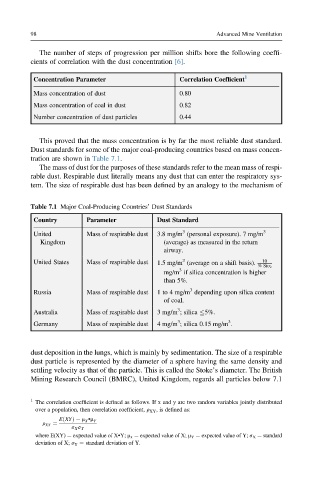
         Dust standards for some of the major coal-producing countries based on mass concen-
         tration are shown in Table 7.1.
            The mass of dust for the purposes of these standards refer to the mean mass of respi-
         rable dust. Respirable dust literally means any dust that can enter the respiratory sys-
         tem. The size of respirable dust has been defined by an analogy to the mechanism of

         Table 7.1 Major Coal-Producing Countries’ Dust Standards


          Country       Parameter          Dust Standard
                                                  3
          United        Mass of respirable dust  3.8 mg/m (personal exposure). 7 mg/m 3
            Kingdom                          (average) as measured in the return
                                             airway.
          United States  Mass of respirable dust  1.5 mg/m (average on a shift basis).  10
                                                  3
                                                                       % Sio 2
                                                 3
                                             mg/m if silica concentration is higher
                                             than 5%.
                                                    3
          Russia        Mass of respirable dust  1 to 4 mg/m depending upon silica content
                                             of coal.
                                                 3
          Australia     Mass of respirable dust  3 mg/m ; silica  5%.
                                                 3
                                                               3
          Germany       Mass of respirable dust  4 mg/m ; silica 0.15 mg/m .
         dust deposition in the lungs, which is mainly by sedimentation. The size of a respirable
         dust particle is represented by the diameter of a sphere having the same density and
         settling velocity as that of the particle. This is called the Stoke’s diameter. The British
         Mining Research Council (BMRC), United Kingdom, regards all particles below 7.1

         1
           The correlation coefficient is defined as follows. If x and y are two random variables jointly distributed
           over a population, then correlation coefficient, r XY ,isdefined as:
                 EðXYÞ  m X •m Y
            r XY ¼
                    s X s Y
           where E(XY) ¼ expected value of X•Y; m x ¼ expected value of X; m Y ¼ expected value of Y; s X ¼ standard
           deviation of X; s Y ¼ standard deviation of Y.

