


Page 238 - Advanced Mine Ventilation
P. 238
Origin of Gases in Coal Mines                                     217

           13.2.5 Carbon Dioxide (Oxygen Depletion)

           It is a colorless, odorless gas with a mild acidic taste in high concentrations. It is heav-
           ier than air (specific gravity 1.5) and thus it accumulates near the mine floor. The coal
           seam as well as the mined out area can be, and usually is, the main source of CO 2 .It is
           an asphyxiating gas. Increasing concentration of CO 2 in air makes breathing faster and
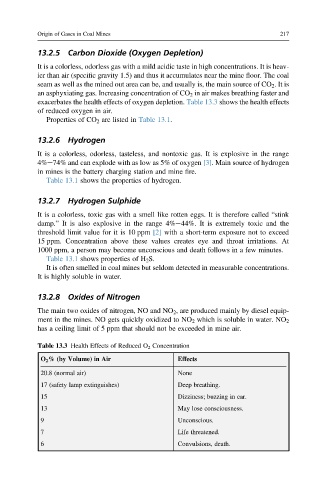
           exacerbates the health effects of oxygen depletion. Table 13.3 shows the health effects
           of reduced oxygen in air.
              Properties of CO 2 are listed in Table 13.1.

           13.2.6 Hydrogen

           It is a colorless, odorless, tasteless, and nontoxic gas. It is explosive in the range
           4%e74% and can explode with as low as 5% of oxygen [3]. Main source of hydrogen
           in mines is the battery charging station and mine fire.
              Table 13.1 shows the properties of hydrogen.

           13.2.7 Hydrogen Sulphide

           It is a colorless, toxic gas with a smell like rotten eggs. It is therefore called “stink
           damp.” It is also explosive in the range 4%e44%. It is extremely toxic and the
           threshold limit value for it is 10 ppm [2] with a short-term exposure not to exceed
           15 ppm. Concentration above these values creates eye and throat irritations. At
           1000 ppm, a person may become unconscious and death follows in a few minutes.
              Table 13.1 shows properties of H 2 S.
              It is often smelled in coal mines but seldom detected in measurable concentrations.
           It is highly soluble in water.


           13.2.8 Oxides of Nitrogen
           The main two oxides of nitrogen, NO and NO 2 , are produced mainly by diesel equip-
           ment in the mines. NO gets quickly oxidized to NO 2 which is soluble in water. NO 2
           has a ceiling limit of 5 ppm that should not be exceeded in mine air.

           Table 13.3 Health Effects of Reduced O 2 Concentration

            O 2 % (by Volume) in Air             Effects
            20.8 (normal air)                    None
            17 (safety lamp extinguishes)        Deep breathing.
            15                                   Dizziness; buzzing in ear.
            13                                   May lose consciousness.
            9                                    Unconscious.
            7                                    Life threatened.
            6                                    Convulsions, death.

