


Page 173 - Advances in bioenergy the sustainability challenge
P. 173
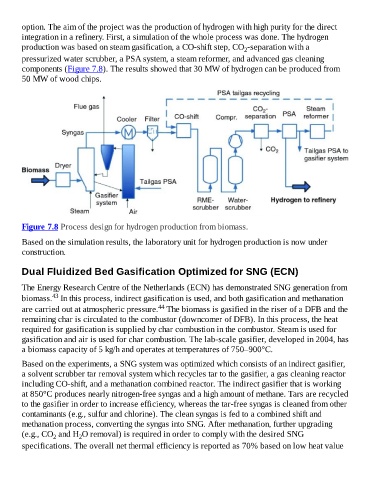
option. The aim of the project was the production of hydrogen with high purity for the direct
        integration in a refinery. First, a simulation of the whole process was done. The hydrogen
        production was based on steam gasification, a CO-shift step, CO -separation with a
                                                                                  2
        pressurized water scrubber, a PSA system, a steam reformer, and advanced gas cleaning
        components (Figure 7.8). The results showed that 30 MW of hydrogen can be produced from
        50 MW of wood chips.


        Figure 7.8 Process design for hydrogen production from biomass.

        Based on the simulation results, the laboratory unit for hydrogen production is now under
        construction.


        Dual Fluidized Bed Gasification Optimized for SNG (ECN)


        The Energy Research Centre of the Netherlands (ECN) has demonstrated SNG generation from
                  43
        biomass.  In this process, indirect gasification is used, and both gasification and methanation
                                                     44
        are carried out at atmospheric pressure.  The biomass is gasified in the riser of a DFB and the
        remaining char is circulated to the combustor (downcomer of DFB). In this process, the heat
        required for gasification is supplied by char combustion in the combustor. Steam is used for
        gasification and air is used for char combustion. The lab-scale gasifier, developed in 2004, has
        a biomass capacity of 5 kg/h and operates at temperatures of 750–900°C.

        Based on the experiments, a SNG system was optimized which consists of an indirect gasifier,
        a solvent scrubber tar removal system which recycles tar to the gasifier, a gas cleaning reactor
        including CO-shift, and a methanation combined reactor. The indirect gasifier that is working

        at 850°C produces nearly nitrogen-free syngas and a high amount of methane. Tars are recycled
        to the gasifier in order to increase efficiency, whereas the tar-free syngas is cleaned from other
        contaminants (e.g., sulfur and chlorine). The clean syngas is fed to a combined shift and
        methanation process, converting the syngas into SNG. After methanation, further upgrading
        (e.g., CO  and H O removal) is required in order to comply with the desired SNG
                           2
                   2
        specifications. The overall net thermal efficiency is reported as 70% based on low heat value

