


Page 286 - Applied Petroleum Geomechanics
P. 286
Abnormal pore pressure mechanisms  275


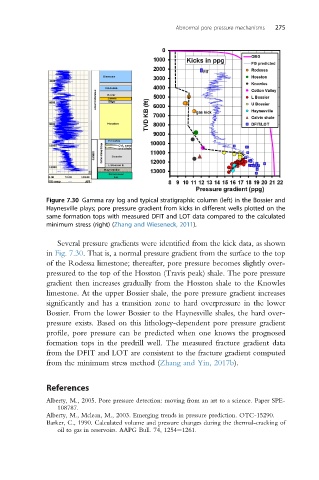
              Figure 7.30 Gamma ray log and typical stratigraphic column (left) in the Bossier and
              Haynesville plays; pore pressure gradient from kicks in different wells plotted on the
              same formation tops with measured DFIT and LOT data compared to the calculated
              minimum stress (right) (Zhang and Wieseneck, 2011).

                 Several pressure gradients were identified from the kick data, as shown
              in Fig. 7.30. That is, a normal pressure gradient from the surface to the top
              of the Rodessa limestone; thereafter, pore pressure becomes slightly over-
              pressured to the top of the Hosston (Travis peak) shale. The pore pressure
              gradient then increases gradually from the Hosston shale to the Knowles
              limestone. At the upper Bossier shale, the pore pressure gradient increases
              significantly and has a transition zone to hard overpressure in the lower
              Bossier. From the lower Bossier to the Haynesville shales, the hard over-
              pressure exists. Based on this lithology-dependent pore pressure gradient
              profile, pore pressure can be predicted when one knows the prognosed
              formation tops in the predrill well. The measured fracture gradient data
              from the DFIT and LOT are consistent to the fracture gradient computed
              from the minimum stress method (Zhang and Yin, 2017b).


              References
              Alberty, M., 2005. Pore pressure detection: moving from an art to a science. Paper SPE-
                 108787.
              Alberty, M., Mclean, M., 2003. Emerging trends in pressure prediction. OTC-15290.
              Barker, C., 1990. Calculated volume and pressure changes during the thermal-cracking of
                 oil to gas in reservoirs. AAPG Bull. 74, 1254e1261.

