


Page 269 - Applied Process Design for Chemical and Petrochemical Plants Volume I
P. 269
242                      Applied Process Design for Chemical and Petrochemical Plants

               The terminal (highest calculated) settling velocity of the   In summary:
             aqueous droplet in/through  the hydrocarbon phase is:
                                                                  Design Calculation            Practical Design Use
               vhc = (1.2) (5 in./min) (95/39 GPM)  = 14.6 in./min
                                                                  Diameter 3.34 ft (40.08 in.)   3.5 ft. (42 in.) or 3.83 ft (46 in.)
                                                                  Length HC inlet/outlet: 11 ft    12 or 14 ft
               Because this is more than the 10 in./min  recommend-
             ed earlier, then use:
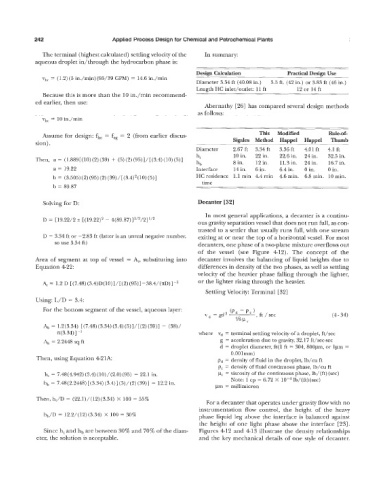
                                                                     Abernathy  [ 261 has compared several design methods
                                                                   as follows:
               vhc = 10 in./min

               Assume for design: fhc = fag = 2  (from earlier discus-                 This   Modified        Rule-of-
             sion).                                                           Sigales  Method  Happel  Happel   Thumb
                                                                  Diameter    2.67 ft  3.34 ft   3.36 ft   4.01 ft   4.1 ft
                                                                  ht          10 in.   22 in.   22.6 in.  24 in.   32.5 in.
             Then,  a = (1.889[(10)(2)(39) + (5)(2)(95)1/[(3.4)(10)(5)1
                                                                  hb          8 in.   12 in.   11.3 in.  24in.   16.7in.
                   a = 19.22                                      Interface   14in.   6in.    6.4in.  0 in.   Oin.
                   b = (3.505)(2)(95)(2)(39)/[(3.4)2(10)(5)1      HC residence  1.1 min  4.4 min  4.6 min.  6.8 rnin.  10 min.
                                                                    time
                   b = 89.87

               Solving for D:                                      Decanter [321

                                                                     In most general applications, a decanter is a continu-
               D   [19.22/2 * [(19.22)2 - 4(89.87)]'/2/2]1/2       ous gravity separation vessel that does not run full, as con-
                                                                   trasted to a settler that usually runs full, with one stream
               D = 3.34 ft or -2.83 ft (latter is an unreal negative number,   exiting at or near the top of a horizontal vessel. For most
                   so use 3.34 ft)                                 decanters, one phase of a two-plane mixture overflows out
                                                                   of  the  vessel  (see  Figure  412).  The  concept  of  the
             Area of  segment at top of vessel  = A,,  substituting into   decanter involves the balancing of liquid heights due to
             Equation 422:                                         differences in density of the two phases, as well as settling
                                                                   velocity of  the heavier phase falling through  the lighter,
               A,  = 1.2 D [(7.48)(3.4)D(10)]/[(2)(95)1-38.4/(xD)]-'   or the lighter rising through the heavier.
                                                                     Settling Velocity: Terminal  [32]
             Using: L/D  = 3.4:
               For the bottom segment of the vessel, aqueous layer:
                                                                                                               (4- 34)

               Ab  = 1.2(3.34) [(7.48)(3.34)(3.4)(5)1/[(2)(39)1 - (38)/
                    x( 3.34) ] -'                                  where  vd  = terminal settling velocity of a droplet, ft/sec
               Ab   2.2448 Sq ft                                          g  = acceleration due to gravity, 32.17 ft/sec-sec
                                                                          d = droplet diameter, ft(1 ft = 304, 800pm, or lpm =
                                                                             0.00 1 mm)
             Then, using Equation 421A                                   Pd  = density of fluid in the droplet, lb/cu  ft
                                                                         pc = density of fluid continuous phase, lb/cu ft
                h,  = 7.48(4.942) (3.4)(10)/(2.0)(95) 22.1 in.           clC = viscosity of the continuous phase, lb/(ft) (sec)
                                             =
                                                                             Note: 1 cp = 6.72 X   lb/(ft) (sec)
               hb = 7.48(2.2448) [(3.34) (3.4)] (5)/(2) (39)l = 12.2 in.
                                                                        pm  = millimicron
             Then, h,/D  = (22.1)/(12)(3.34) X  100 = 55%
                                                                     For a decanter that operates under gravity flow with no
                                                                   instrumentation  flow  control,  the  height  of  the  heavy
               hb/D = 12.2/(12)(3.34) X  100 = 30%                 phase  liquid  leg above the interface is balanced  against
                                                                   the  height  of  one light  phase  above the  interface  [23].
               Since h, and hb are between 30% and 70% of the diam-   Figures 412 and 413 illustrate the density relationships
             eter, the solution is acceptable.                     and the key  mechanical  details of one style of  decanter.

