


Page 600 - Battery Reference Book
P. 600
Nickel-cadmium secondary batteries  51/37
         1.4r                                    1.  Electrolyte  supply is unnecessary  and the batteries
                                                   are perfectly  sealed.
                                                 2.  All forms of  quick charging are permitted.
                                                 3.  Because the batteries are perfectly sealed they may
                                                   be  placed  in  any  position  to  meet  specific  usage
                                                   requirements.
                                         I       4.  The batteries  can be  used  repeatedly,  for as many
           20  30   40   50   60  70  80   90  100   as 300-3000  times (depending on the charging and
                       Capacity (%I                discharging conditions).
       (a)  ZA series
                                                 5.  They possess excellent electrical characteristics and
                                                   one  can  obtain  d.c.  current  of  uninterrupted  high
         2.8r
                                                   efficiency because there is hardly any internal res-
                                                   istance.
                                                 6.  The batteries  are suitable for all emergency power
                                                   requirements,  when the battery  is left in the  float-
                                                   charge state.
                                                 7.  Permits  overcharge and overdischarge.
           20   30   40   50   60  70   80   90  100   The Yuasa button Fcell is suitable for standard dis-
       (b) Z22A series   Capacity (%I            charge requirements while the button FZ cell is suitable
                                                 for high-rate discharge (for charge and discharge char-
         1.4 r                                   acteristics see Figure 5 1.27). The Yuasa RS-type cylin-
                                                 drical cell is for high-rate  discharge  applications,  the
                                                 NR-11 cell for high-temperature trickle charge require-
       ,  , T b 2  .  1’.’  Discharye current
                                                 ments and the RSF cell for quick charging.
                                                   RS cells ensure steady and stable voltage even when
       ’       l   20 x I,o   20 x  “lo   10 x Il0  2 x I,,   internal  resistance  diminishes  and  discharge  current
                   (DAonly)  (VAonly)
                                                 increases.  These cells  can readily  be  used  instead  of
                   I  I   I   I  I   I   I
           20  30   40   50   60  70   80   90   100   dry cells.
       IC) DA and VA series   (%)                  NR-H cells maintain their rated capacity even under
                                                 high-temperature  conditions and are more suitable for
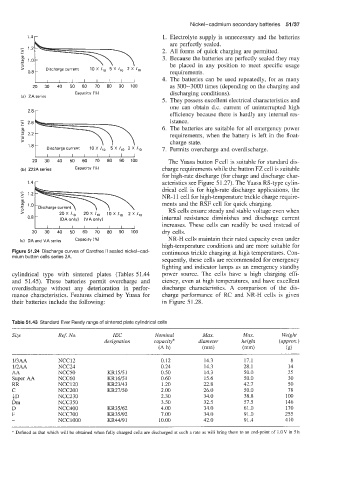
     Figure 51.24  Discharge curves of Carefree II sealed nickel-cad-   continuous trickle charging at high temperatures. Con-
     mium button cells series 2A.
                                                 sequently, these cells are recommended for emergency
                                                 lighting and indicator lamps as an emergency standby
     cylindrical  type  with  sintered  plates  (Tables 51.44   power  source.  The  cells  have  a  high  charging  effi-
     and  51.45).  These  batteries  permit  overcharge  and   ciency, even at high temperatures,  and have excellent
     overdischarge  without  any  deterioration  in  perfor-   discharge  characteristics.  A  comparison  of  the  dis-
     mance  characteristics.  Features  claimed  by  Yuasa for   charge  performance  of  RC  and  NR-H  cells  is  given
     their batteries  include the following:     in Figure 51.28.


     Table 51.43 Standard Ever Ready range of sintered plate cylindrical cells
     Size         Re$  No.        IEC          Nominal       Max.        MU.        Weight
                                designation    capacity*    diameter    height     (approx. 1
                                                (A h)        (mm)        (mm)        (g)
     113AA        NCC 12                         0.12        14.3        17.1          8
     1l2AA        NCC24                          0.24        14.3        28.1         14
     AA           NCC5O          KR15/51         0.50        14.3        50.0         25
     Super AA     NCC60          KR16/5  1       0.60        15.6        50.0         30
     RR           NCC 120        KR23/43         1.20        22.8        42.7         50
     C            NCC200         KR27/50         2.00        26.0        50.0         78
     $D           NCC230                         2.30        34.0        38.8        100
     Dm           NCC350                         3.50        32.5        51.5        146
     D            NCC400         KR35/62         4.00        34.0        61.0        170
     F            NCC700         KR35/92         7.00        34.0        91.0        255
     -            NCClOOO        KR44/9  1      10.00        42.0        91.4        410
     * Defined as that which will be obtained when fully charged cells are discharged at such a rate as will bring them to an end-point of  1.OV in 5 h

