


Page 158 - Beyond Decommissioning
P. 158
Experience and lessons learned                                    139

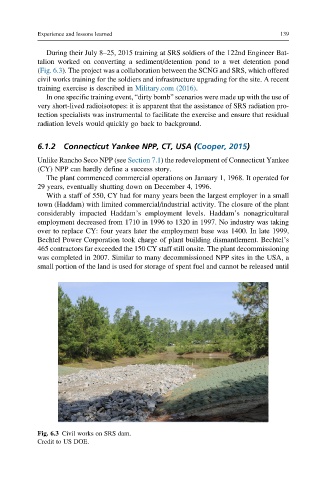
              During their July 8–25, 2015 training at SRS soldiers of the 122nd Engineer Bat-
           talion worked on converting a sediment/detention pond to a wet detention pond
           (Fig. 6.3). The project was a collaboration between the SCNG and SRS, which offered
           civil works training for the soldiers and infrastructure upgrading for the site. A recent
           training exercise is described in Military.com (2016).
              In one specific training event, “dirty bomb” scenarios were made up with the use of
           very short-lived radioisotopes: it is apparent that the assistance of SRS radiation pro-
           tection specialists was instrumental to facilitate the exercise and ensure that residual
           radiation levels would quickly go back to background.


           6.1.2 Connecticut Yankee NPP, CT, USA (Cooper, 2015)
           Unlike Rancho Seco NPP (see Section 7.1) the redevelopment of Connecticut Yankee
           (CY) NPP can hardly define a success story.
              The plant commenced commercial operations on January 1, 1968. It operated for
           29 years, eventually shutting down on December 4, 1996.
              With a staff of 550, CY had for many years been the largest employer in a small
           town (Haddam) with limited commercial/industrial activity. The closure of the plant
           considerably impacted Haddam’s employment levels. Haddam’s nonagricultural
           employment decreased from 1710 in 1996 to 1320 in 1997. No industry was taking
           over to replace CY: four years later the employment base was 1400. In late 1999,
           Bechtel Power Corporation took charge of plant building dismantlement. Bechtel’s
           465 contractors far exceeded the 150 CY staff still onsite. The plant decommissioning
           was completed in 2007. Similar to many decommissioned NPP sites in the USA, a
           small portion of the land is used for storage of spent fuel and cannot be released until


           Fig. 6.3 Civil works on SRS dam.
           Credit to US DOE.

