


Page 244 - Big Data Analytics for Intelligent Healthcare Management
P. 244
9.3 HEALTH RECOMMENDATION SYSTEM             237


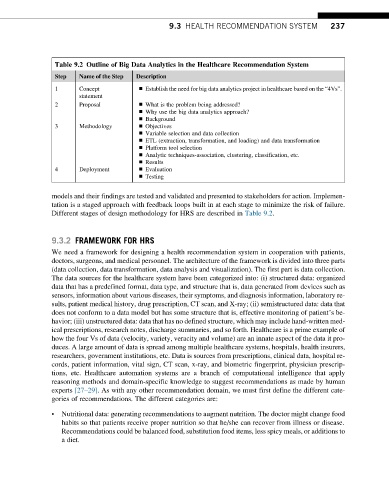
                Table 9.2 Outline of Big Data Analytics in the Healthcare Recommendation System
                Step   Name of the Step  Description
                1      Concept          n Establish the need for big data analytics project in healthcare based on the “4Vs”.
                       statement
                2      Proposal         n What is the problem being addressed?
                                        n Why use the big data analytics approach?
                                        n Background
                3      Methodology      n Objectives
                                        n Variable selection and data collection
                                        n ETL (extraction, transformation, and loading) and data transformation
                                        n Platform tool selection
                                        n Analytic techniques-association, clustering, classification, etc.
                                        n Results
                4      Deployment       n Evaluation
                                        n Testing


               models and their findings are tested and validated and presented to stakeholders for action. Implemen-
               tation is a staged approach with feedback loops built in at each stage to minimize the risk of failure.
               Different stages of design methodology for HRS are described in Table 9.2.


               9.3.2 FRAMEWORK FOR HRS
               We need a framework for designing a health recommendation system in cooperation with patients,
               doctors, surgeons, and medical personnel. The architecture of the framework is divided into three parts
               (data collection, data transformation, data analysis and visualization). The first part is data collection.
               The data sources for the healthcare system have been categorized into: (i) structured data: organized
               data that has a predefined format, data type, and structure that is, data generated from devices such as
               sensors, information about various diseases, their symptoms, and diagnosis information, laboratory re-
               sults, patient medical history, drug prescription, CT scan, and X-ray; (ii) semistructured data: data that
               does not conform to a data model but has some structure that is, effective monitoring of patient’s be-
               havior; (iii) unstructured data: data that has no defined structure, which may include hand-written med-
               ical prescriptions, research notes, discharge summaries, and so forth. Healthcare is a prime example of
               how the four Vs of data (velocity, variety, veracity and volume) are an innate aspect of the data it pro-
               duces. A large amount of data is spread among multiple healthcare systems, hospitals, health insurers,
               researchers, government institutions, etc. Data is sources from prescriptions, clinical data, hospital re-
               cords, patient information, vital sign, CT scan, x-ray, and biometric fingerprint, physician prescrip-
               tions, etc. Healthcare automation systems are a branch of computational intelligence that apply
               reasoning methods and domain-specific knowledge to suggest recommendations as made by human
               experts [27–29]. As with any other recommendation domain, we must first define the different cate-
               gories of recommendations. The different categories are:
               •  Nutritional data: generating recommendations to augment nutrition. The doctor might change food
                  habits so that patients receive proper nutrition so that he/she can recover from illness or disease.
                  Recommendations could be balanced food, substitution food items, less spicy meals, or additions to
                  a diet.

