


Page 176 - Biobehavioral Resilence to Stress
P. 176
Resilience and Survival in Extreme Environments                 153


                                                                            Mean + SEM (n=18)
                                                                                −
                                                                            Resistant subject
                                                                            Vulnerable subject
                                  0.0050
                                  0.0045
                                  0.0040
                                  0.0035
                                 PVT speed  0.0030
                                  0.0025

                                  0.0020
                                  0.0015
                                  0.0010
                                  0.0005
                                  0.0000
                                         1   2   3   4   5   6   7   8    9  10  11  12  13
                                          Baseline          Sleep restriction      Recovery
                                          8 h/night           3 h/night            8 h/night
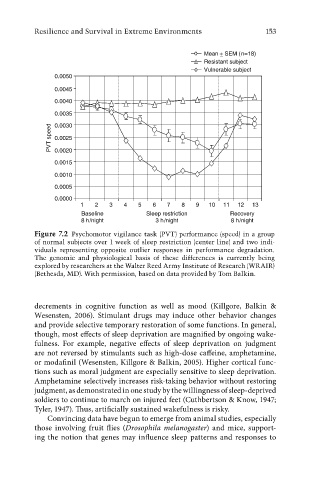
                             Figure 7.2  Psychomotor vigilance task (PVT) performance (speed) in a group
                             of normal subjects over 1 week of sleep restriction (center line) and two indi-
                             viduals representing opposite outlier responses in performance degradation.
                             The genomic and physiological basis of these differences is currently being
                             explored by researchers at the Walter Reed Army Institute of Research (WRAIR)
                             (Bethesda, MD). With permission, based on data provided by Tom Balkin.


                              decrements in cognitive function as well as mood (Killgore, Balkin &
                              Wesensten, 2006). Stimulant drugs may induce other behavior changes
                             and provide selective temporary restoration of some functions. In general,

                             though, most effects of sleep deprivation are magnified by ongoing wake-

                             fulness. For example, negative effects of sleep deprivation on judgment

                             are not reversed by stimulants such as high-dose caff eine, amphetamine,
                             or modafinil (Wesensten, Killgore & Balkin, 2005). Higher cortical func-

                             tions such as moral judgment are especially sensitive to sleep deprivation.
                             Amphetamine selectively increases risk-taking behavior without restoring
                             judgment, as demonstrated in one study by the willingness of sleep-deprived
                             soldiers to continue to march on injured feet (Cuthbertson & Know, 1947;
                             Tyler, 1947). Th us, artificially sustained wakefulness is risky.

                                Convincing data have begun to emerge from animal studies, especially
                             those involving fruit fl ies  (Drosophila melanogaster) and mice, support-
                             ing the notion that genes may influence sleep patterns and responses to


                                                                                             12/15/2007   3:33:07 PM
                    CRC_71777_Ch007.indd   153                                               12/15/2007   3:33:07 PM
                    CRC_71777_Ch007.indd   153

