


Page 308 - Biomass Gasification, Pyrolysis And Torrefaction Practical Design and Theory
P. 308
284 Biomass Gasification, Pyrolysis and Torrefaction
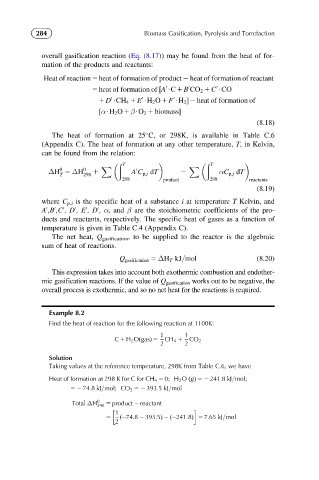
overall gasification reaction (Eq. (8.17)) may be found from the heat of for-
mation of the products and reactants:
Heat of reaction5heat of formation of product heat of formation of reactant
0
0
5heat of formation of ½A UC1B CO 2 1C UCO
0
0
0
1D UCH 4 1E UH 2 O1F UH 2 heat of formation of
0
½αUH 2 O1βUO 2 1biomass
(8.18)
The heat of formation at 25 C, or 298K, is available in Table C.6
(Appendix C). The heat of formation at any other temperature, T, in Kelvin,
can be found from the relation:
ð T X ð T
X
0
0
ΔH 5 ΔH 0 1 A C p;j dT 2 αC p;j dT
T 298
298 product 298 reactants
(8.19)
where C p,i is the specific heat of a substance i at temperature T Kelvin, and
A ,B ,C ,D ,E ,D , α, and β are the stoichiometric coefficients of the pro-
0
0
0
0
0
0
ducts and reactants, respectively. The specific heat of gases as a function of
temperature is given in Table C.4 (Appendix C).
The net heat, Q gasification , to be supplied to the reactor is the algebraic
sum of heat of reactions.
Q gasification 5 ΔH T kJ=mol (8.20)
This expression takes into account both exothermic combustion and endother-
mic gasification reactions. If the value of Q gasification works out to be negative, the
overall process is exothermic, and so no net heat for the reactions is required.
Example 8.2
Find the heat of reaction for the following reaction at 1100K:
1 1
C 1 H 2 OðgasÞ 5 CH 4 1 CO 2
2 2
Solution
Taking values at the reference temperature, 298K from Table C.6, we have
Heat of formation at 298 K for C for CH 4 5 0; H 2 O ðgÞ 52 241:8kJ=mol;
52 74:8kJ=mol; CO 2 52 393:5kJ=mol
Total ΔH 0 5 product 2 reactant
298
1
5 ð274:8 2 393:5Þ 2 ð2241:8Þ 5 7:65 kJ=mol
2

