


Page 107 - Biorefinery 2030 Future Prospects for the Bioeconomy (2015)
P. 107
2  Different Aspects of Industrial Symbiosis at the Bazancourt-Pomacle Biorefinery  75

            raw materials processed on site, sugar beet, has a high concentration of water. This
            water is recovered and processed as a by-product. It is called condensed water.


            2.3.1  The Importance of Water and Its Productivity
            Independently of the symbiosis issue, it should first be noted that water is one of the
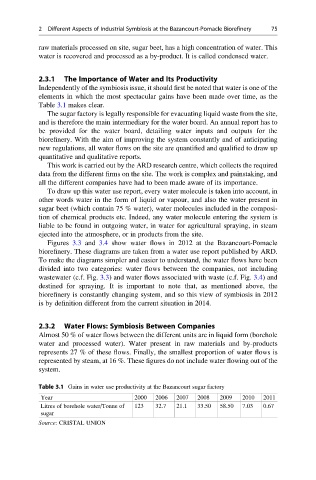
            elements in which the most spectacular gains have been made over time, as the
            Table 3.1 makes clear.
              The sugar factory is legally responsible for evacuating liquid waste from the site,
            and is therefore the main intermediary for the water board. An annual report has to
            be provided for the water board, detailing water inputs and outputs for the
            biorefinery. With the aim of improving the system constantly and of anticipating
            new regulations, all water flows on the site are quantified and qualified to draw up
            quantitative and qualitative reports.
              This work is carried out by the ARD research centre, which collects the required
            data from the different firms on the site. The work is complex and painstaking, and
            all the different companies have had to been made aware of its importance.
              To draw up this water use report, every water molecule is taken into account, in
            other words water in the form of liquid or vapour, and also the water present in
            sugar beet (which contain 75 % water), water molecules included in the composi-
            tion of chemical products etc. Indeed, any water molecule entering the system is
            liable to be found in outgoing water, in water for agricultural spraying, in steam
            ejected into the atmosphere, or in products from the site.
              Figures 3.3 and 3.4 show water flows in 2012 at the Bazancourt-Pomacle
            biorefinery. These diagrams are taken from a water use report published by ARD.
            To make the diagrams simpler and easier to understand, the water flows have been
            divided into two categories: water flows between the companies, not including
            wastewater (c.f. Fig. 3.3) and water flows associated with waste (c.f. Fig. 3.4) and
            destined for spraying. It is important to note that, as mentioned above, the
            biorefinery is constantly changing system, and so this view of symbiosis in 2012
            is by definition different from the current situation in 2014.


            2.3.2  Water Flows: Symbiosis Between Companies
            Almost 50 % of water flows between the different units are in liquid form (borehole
            water and processed water). Water present in raw materials and by-products
            represents 27 % of these flows. Finally, the smallest proportion of water flows is
            represented by steam, at 16 %. These figures do not include water flowing out of the
            system.

            Table 3.1 Gains in water use productivity at the Bazancourt sugar factory
            Year                      2000  2006  2007  2008  2009  2010  2011
            Litres of borehole water/Tonne of  123  32.7  21.1  33.50  58.50  7.03  0.67
            sugar
            Source: CRISTAL UNION

