


Page 201 - Boiler Operator’s Handbook
P. 201
186                                                                               Boiler Operator’s Handbook

               screws that are just long enough to do the job so you  prevent bypassing, structural problems with the con-
               don’t waste time removing and replacing long ones.   struction of the air handling unit or simply that the coil
                    Hinged access doors need to have those hinges  is dirty. Note that a dirty coil is detected by bypass fac-
               lubricated. Hear a squeak when you’re opening one?  tor, not  by higher  than normal outlet temperatures. A
               That’s the AHU telling you it needs lubrication. You can  higher than design air pressure drop across the coil is
               also note that the hinges are worn down (cheap ones do  also an indication. A dirty coil, like a dirty filter, changes
               that in a few years). You may have to replace them to  the air flow which normally results in cooler unit outlet
               get the door to fit properly but the first thing I always  temperatures because the coil has less air to cool. These
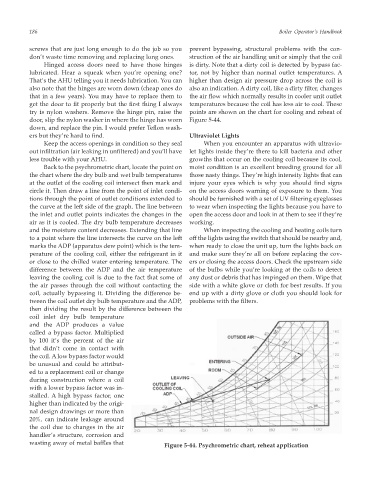
               try is nylon washers. Remove the hinge pin, raise the  points are shown on the chart for cooling and reheat of
               door, slip the nylon washer in where the hinge has worn  Figure 5-44.
               down, and replace the pin. I would prefer Teflon wash-
               ers but they’re hard to find.                        Ultraviolet Lights
                    Keep the access openings in condition so they seal     When you encounter an apparatus with ultravio-
               out infiltration (air leaking in unfiltered) and you’ll have  let lights inside they’re there to kill bacteria and other
               less trouble with your AHU.                          growths that occur on the cooling coil because its cool,
                    Back to the psychrometric chart, locate the point on  moist condition is an excellent breeding ground for all
               the chart where the dry bulb and wet bulb temperatures  those nasty things. They’re high intensity lights that can
               at the outlet of the cooling coil intersect then mark and  injure  your  eyes  which  is  why  you  should  find  signs
               circle it. Then draw a line from the point of inlet condi-  on the access doors warning of exposure to them. You
               tions through the point of outlet conditions extended to  should be furnished with a set of UV filtering eyeglasses
               the curve at the left side of the graph. The line between  to wear when inspecting the lights because you have to
               the inlet and outlet points indicates the changes in the  open the access door and look in at them to see if they’re
               air as it is cooled. The dry bulb temperature decreases  working.
               and the moisture content decreases. Extending that line     When inspecting the cooling and heating coils turn
               to a point where the line intersects the curve on the left  off the lights using the switch that should be nearby and,
               marks the ADP (apparatus dew point) which is the tem-  when ready to close the unit up, turn the lights back on
               perature of the cooling coil, either the refrigerant in it  and make sure they’re all on before replacing the cov-
               or close to the chilled water entering temperature. The  ers or closing the access doors. Check the upstream side
               difference  between  the  ADP  and  the  air  temperature  of the bulbs while you’re looking at the coils to detect
               leaving the cooling coil is due to the fact that some of  any dust or debris that has impinged on them. Wipe that
               the air passes through the coil without contacting the  side with a white glove or cloth for best results. If you
               coil,  actually  bypassing  it.  Dividing  the  difference  be-  end up with a dirty glove or cloth you should look for
               tween the coil outlet dry bulb temperature and the ADP,  problems with the filters.
               then dividing the result by the difference between the
               coil inlet dry bulb temperature
               and the  ADP produces a value
               called a  bypass  factor.  Multiplied
               by 100 it’s the percent of the air
               that didn’t come in contact with
               the coil. A low bypass factor would
               be unusual and could be attribut-
               ed to a replacement coil or change
               during construction where a coil
               with a lower bypass factor was in-
               stalled. A high bypass factor, one
               higher than indicated by the origi-
               nal design drawings or more than
               20%,  can  indicate  leakage  around
               the coil due to changes in the air
               handler’s structure, corrosion and
               wasting away of metal baffles that
                                                           Figure 5-44. Psychrometric chart, reheat application

