


Page 212 - Calculus Workbook For Dummies
P. 212
196       Part IV: Integration and Infinite Series


                *5. What’s  #  x e dx? Tip: Sometimes you      *6. Integrate  # e  x  sinx dx. Tip: Sometimes you
                                 x
                                -
                              2
                    have to do integration by parts more            circle back to where you started from —
                    than once.                                      that’s a good thing!
                Solve It                                        Solve It


                Transfiguring Trigonometric Integrals


                          Don’t you just love trig? I’ll bet you didn’t realize that studying calculus was going to
                          give you the opportunity to do so much more trig. Remember this next Thanksgiving
                          when everyone around the dinner table is invited to mention something that they’re
                          thankful for.

                          This section lets you practice integrating expressions containing trigonometric func-
                          tions. The basic idea is to fiddle with the integrand until you’re able to finish with a
                          u-substitution (see Chapter 10). In the next section, you use some fancy trigonometric
                          substitutions to solve integrals that don’t contain trig functions.


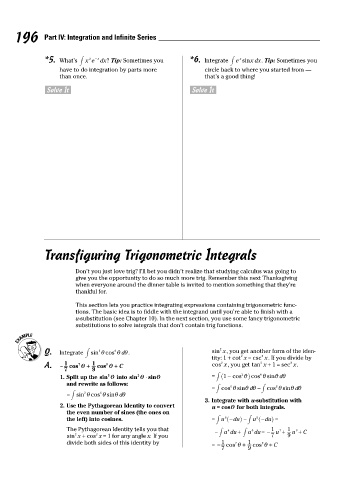
                Q.   Integrate  # sin i cos i  di.                    sin x, you get another form of the iden-
                                                                         2
                                 3
                                      6
                                                                                2
                                                                                       2
                                                                      tity: 1 +  cot x =  csc x. If you divide by
                A.   -  1  cos i  +  1  cos i  +  C                   cos x, you get tan x + =  sec x.
                                                                         2
                                                                                      2
                                                                                                2
                                                                                          1
                           7
                                    9
                      7        9
                                                                                2
                                                                                           i
                                                                                      6
                     1. Split up the sin i into sin i $  sini         = # _ 1 -  cos ii cos i sin di
                                              2
                                    3
                       and rewrite as follows:                        = #  cos i sin d -i i #  cos i  sin di
                                                                            6
                                                                                           8
                                                                                                i
                       = #  sin i  cos i  sin di
                             2
                                       i
                                  6
                                                                    3. Integrate with u-substitution with
                     2. Use the Pythagorean Identity to convert       u =  cosi for both integrals.
                       the even number of sines (the ones on
                                                                                     8
                                                                           6
                       the left) into cosines.                        = #  u - du - #  u - du =
                                                                                          h
                                                                                     ^
                                                                               h
                                                                           ^
                       The Pythagorean Identity tells you that         - # u du + # u du = - 1  u +  1  u +  C
                                                                                            7
                                                                                   8
                                                                           6
                                                                                                  9
                                    1
                                2
                          2
                       sin x +  cos x = for any angle x. If you                           7    9
                       divide both sides of this identity by             1    7   1    9
                                                                      = -  cos i  +  cos i  +  C
                                                                         7        9

