


Page 218 - Calculus Workbook For Dummies
P. 218
202 Part IV: Integration and Infinite Series
4
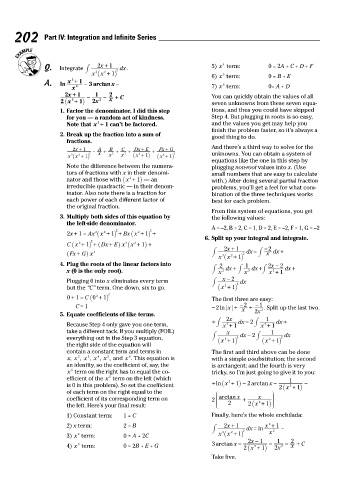
Q. Integrate # 2 x + 1 dx. 5) x term: 0 = 2A + C + D + F
3
2
x x + 1i 2 5
_
6) x term: 0 = B + E
A. ln x + 1 - 3 arctanx - 6
2
x 2 7) x term: 0= A + D
2 x + 1 - 1 2 - 2 + C You can quickly obtain the values of all
2
2 _ x + 1i 2 x x seven unknowns from these seven equa-
1. Factor the denominator. I did this step tions, and thus you could have skipped
for you — a random act of kindness. Step 4. But plugging in roots is so easy,
2
Note that x + 1 can’t be factored. and the values you get may help you
finish the problem faster, so it’s always a
2. Break up the fraction into a sum of good thing to do.
fractions.
And there’s a third way to solve for the
2 x + 1 A + B C Dx + E + Fx + G
2
3 2 2 = x x 2 + x 3 + _ x + 1i 2 2 unknowns. You can obtain a system of
x _ x + 1i _ x + 1i
equations like the one in this step by
Note the difference between the numera- plugging non-root values into x. (Use
tors of fractions with x in their denomi- small numbers that are easy to calculate
2
nator and those with x + 1i — an with.) After doing several partial fraction
_
irreducible quadractic — in their denom- problems, you’ll get a feel for what com-
inator. Also note there is a fraction for bination of the three techniques works
each power of each different factor of best for each problem.
the original fraction.
From this system of equations, you get
3. Multiply both sides of this equation by the following values:
the left-side denominator.
A = –2, B = 2, C = 1, D = 2, E = –2, F = 1, G = –2
2 2 2
2
2
2 x + = Ax x + i Bx x + i
1
1 +
1 +
_
_
6. Split up your integral and integrate.
2 3 2
2
C x + i Dx + h _ 1 + 2 x + 1 - 2
1 + ^
E x x + i
_
^ Fx + G x 3 # 3 2 2 dx = # x dx +
h
x x + 1i
_
4. Plug the roots of the linear factors into # 2 dx + # 1 dx +# 2 x - 2
x (0 is the only root). x 2 x 3 x + 1 dx +
2
Plugging 0 into x eliminates every term # x - 2 2 dx
2
but the “C” term. One down, six to go. _ x + 1i
2
1
2
0 + = C 0 + 1i The first three are easy:
_
C = 1 - 2 ln x + - x 2 + - 1 2 . Split up the last two.
5. Equate coefficients of like terms. 2 x
+ # 2 x dx - # 1 dx +
2
Because Step 4 only gave you one term, x + 1 x + 1
2
2
take a different tack. If you multiply (FOIL) # x dx - # 1
everything out in the Step 3 equation, _ x + 1i 2 2 _ x + 1i 2 dx
2
2
the right side of the equation will
contain a constant term and terms in The first and third above can be done
, x x 2 , x 3 , x 4 , x 5 , and x . This equation is with a simple u-substitution; the second
6
an identity, so the coefficient of, say, the is arctangent; and the fourth is very
5
x term on the right has to equal the co- tricky, so I’m just going to give it to you:
5
efficient of the x term on the left (which 1
2
1 -
_
is 0 in this problem). So set the coefficient + ln x + i 2 arctan x - 2 _ x + 1i -
2
of each term on the right equal to the J N
coefficient of its corresponding term on 2 K K arctan x + x O
1 O
2
the left. Here’s your final result: L 2 2 _ x + i P
1) Constant term: 1 = C Finally, here’s the whole enchilada:
2) x term: 2 = B # 2 x + 1 2 dx = ln x + 2 1 -
2
2
3
_
2
3) x term: 0 = A + 2C x x + 1i x
2 x - 1 1 2
3
4) x term: 0 = 2B + E + G 3 arctan x - 2 - 2 - x + C
2 _ x + 1i 2 x
Take five.

