


Page 261 - Calculus Workbook For Dummies
P. 261
245
                                                    Chapter 13: Infinite Series: Welcome to the Outer Limits


                Testing Three Basic Series


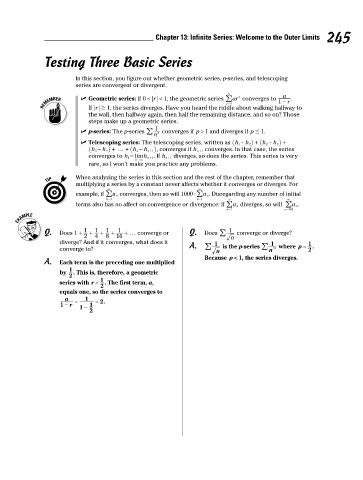
                          In this section, you figure out whether geometric series, p-series, and telescoping
                          series are convergent or divergent.
                                                                           3
                                                                               n
                             Geometric series: If  < r0  < 1, the geometric series ! ar converges to   a  .
                                                                           n 0              1 -  r
                                                                            =
                              If  r $  1, the series diverges. Have you heard the riddle about walking halfway to
                              the wall, then halfway again, then half the remaining distance, and so on? Those
                              steps make up a geometric series.
                             p-series: The p-series !  1 p converges if  >p 1 and diverges if p #  1.
                                                   n
                             Telescoping series: The telescoping series, written as  h 1 -  h 2 + _ h 2 -  h 3 +
                                                                             _
                                                                                   i
                                                                                            i
                                    i
                              _ h 3 -  h 4 +  ... + _ h n -  h n 1+ i, converges if h n 1+ converges. In that case, the series
                              converges to h 1 -  limh n 1+ . If h n 1+ diverges, so does the series. This series is very
                                             n " 3
                              rare, so I won’t make you practice any problems.
                          When analyzing the series in this section and the rest of the chapter, remember that
                          multiplying a series by a constant never affects whether it converges or diverges. For
                                                                  3
                                    3
                          example, if ! u n converges, then so will 1000$ ! . Disregarding any number of initial
                                                                   u n
                                                                                               3
                                                                 n 1
                                                                            3
                                                                  =
                                    =
                                    n 1
                          terms also has no affect on convergence or divergence: If ! u n diverges, so will  ! .
                                                                                                u n
                                                                           n 1                n 982
                                                                                               =
                                                                            =
                Q.   Does 1 +  1  +  1  +  1  +  1  +  ... converge or   Q.  Does !  1  converge or diverge?
                             2  4   8  16                                   n
                     diverge? And if it converges, what does it  A. !  1  is the p-series !  1        1
                     converge to?                                                        n  / 1 2 where p =  2 .
                                                                        n
                A.   Each term is the preceding one multiplied      Because  <p 1, the series diverges.
                        1
                     by  . This is, therefore, a geometric
                        2
                     series with r =  1  . The first term, a,
                                  2
                     equals one, so the series converges to
                      a  =   1  =  2.
                     1 -  r   1
                           1 -
                              2

