


Page 267 - Calculus Workbook For Dummies
P. 267
251
                                                    Chapter 13: Infinite Series: Welcome to the Outer Limits


                Ratiocinating the Two “R” Tests


                          Here you practice the ratio test and the root test. With both tests, a result less than 1
                          means that the series in question converges; a result greater than 1 means that the
                          series diverges; and a result of 1 tells you nothing.

                             The ratio test: Given a series ! , consider the limit of the ratio of a term to the
                                                          u n
                              previous term, lim  u n 1+  . If this limit is less than 1, the series converges. If it’s
                                           n " 3  u n
                              greater than 1 (this includes 3), the series diverges. And if it equals 1, the ratio
                              test tells you nothing.
                             The root test: Note its similarity to the ratio test. Given a series ! , consider
                                                                                       u n
                              the limit of the nth root of the nth term, lim  n  u n . If this limit is less than 1, the
                                                                 n " 3
                              series converges. If it’s greater (including 3), the series diverges. And if it equals
                              1, the root test says nothing.

                          The ratio test is a good test to try if the series involves factorials like  !n or where n is
                                          n
                          in the power like 2 . The root test also works well when the series contains nth
                          powers. If you’re not sure which test to try first, start with the ratio test — it’s often
                          the easier to use.
                          Sometimes it’s useful to have an idea about the convergence or divergence of a series
                          before using one of the tests to prove convergence or divergence.


                          3
                                                                         3
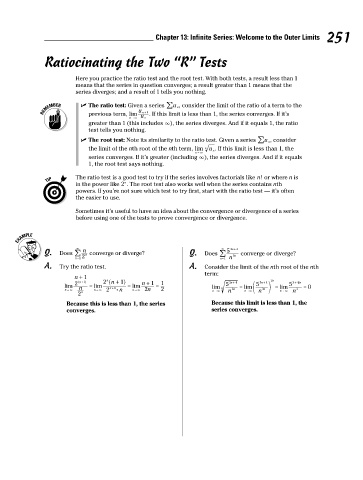
                Q.   Does !  n n converge or diverge?          Q.   Does ! 5 3 n + n converge or diverge?
                                                                              4
                          n 1  2                                         n 1  n 3
                          =
                                                                          =
                A.   Try the ratio test.                       A.   Consider the limit of the nth root of the nth
                                                                    term:
                         n +  1     n
                         2  (n 1 )  2 ^ n +  1h  n +  1  1                 5  3 n +  4  5  3 n +  4  1 /n  5  3 +  4 /n
                            +
                      lim  n  =  lim  n 1  =  lim   =                 lim n  n =  limd  n n  =  lim  3 =  0
                                      +
                      n " 3  n  n " 3  2  :  n  n " 3  2 n  2         n " 3  n  3  n " 3  n 3  n " 3  n
                          2
                       Because this is less than 1, the series        Because this limit is less than 1, the
                       converges.                                     series converges.

