


Page 277 - Calculus Workbook For Dummies
P. 277
261
                                                    Chapter 13: Infinite Series: Welcome to the Outer Limits


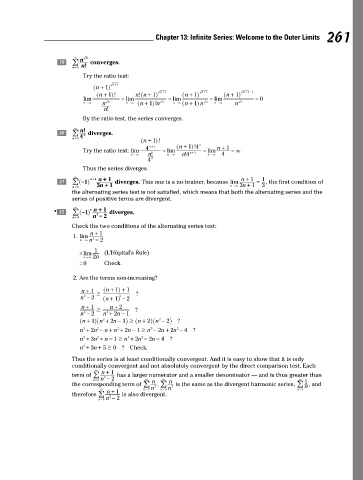
                    s !    n  n  converges.
                         3
                         n 1  ! n
                          =
                            Try the ratio test:
                                      n 1
                                       +
                               ^ n +  1h
                                                     n 1           n 1          n 1 1
                                                      +
                                                                    +
                                                                                 + -
                                ^ n +  1h  !  ! n n +  1h    ^ n +  1h    ^ n +  1h
                                               ^
                            lim          =  lim         =  lim        =  lim        =  0
                                  n           ^ n +  1h !n   ^ n +  1h n      n
                            n " 3   n     n " 3       n   n " 3     n  n " 3    n
                                    ! n
                            By the ratio test, the series converges.
                         3
                    t !     ! n n diverges.
                          =
                         n 1 4
                                               ^ n +  1h !
                                                   +
                                                 4  n 1    ^ n +  1h  !4 n  n +  1
                            Try the ratio test: lim   =  lim   n 1  =  lim   =  3
                                                                +
                                            n " 3  ! n  n " 3  ! n 4  n " 3  4
                                                 4  n
                            Thus the series diverges.
                         3    n 1  n +  1                                       n +  1  1
                               +
                    u !^    - 1h       diverges. This one is a no-brainer, because lim  =  , the first condition of
                         n 1     3 n +  1                                   n " 3  3 n +  1  3
                          =
                         the alternating series test is not satisfied, which means that both the alternating series and the
                         series of positive terms are divergent.
                         3
                              n  n +  1
                   *v !^    - 1h  2  diverges.
                          =
                         n 3   n -  2
                         Check the two conditions of the alternating series test:
                              n +  1
                         1. lim
                               2
                           n " 3  n -  2
                                1
                           = lim   (L’Hôpital’s Rule)
                            n " 3  2 n
                           = 0     Check.
                         2. Are the terms non-increasing?
                                       1 +
                            n +  1  $  ^ n + h  1  ?
                            2
                           n -  2  ^ n + h 2  2
                                       1 -
                            n +  1  $  n +  2  ?
                                    2
                            2
                           n -  2  n +  2 n -  1
                                   2
                                                     2
                                                 2 _
                           ^ n + h  n +  2 n - i  n + h  n -  2i  ?
                                         1 $ ^
                               1 _
                                                           2
                                       2
                                 2
                            3
                                                  3
                           n +  2 n -  n +  n +  2 n -  1 $  n -  2 n +  2 n -  4  ?
                                           3
                            3
                                               2
                                 2
                           n +  3 n +  n -  1 $  n +  2 n -  2 n -  4  ?
                            2
                           n +  3 n +  5 $  0  ? Check .
                         Thus the series is at least conditionally convergent. And it is easy to show that it is only
                         conditionally convergent and not absolutely convergent by the direct comparison test. Each
                                3
                         term of !  n +  1  has a larger numerator and a smaller denominator — and is thus greater than
                                   2
                                     2
                                  n -
                                                      3
                         the corresponding term of !  n 2 . !  n 2 is the same as the divergent harmonic series, ! , and
                                                3
                                                                                                   3
                                                                                                     1
                                =
                               n 3
                                                                                                     n
                                                  n
                                                n 3
                                                                                                   =
                                  3
                                                      =
                                                     n 3
                                                 =
                         therefore !  n +  1  is also divergent.  n                               n 3
                                     2
                                  =
                                 n 3  n -  2

