


Page 133 - Carbonate Facies in Geologic History
P. 133
120                         The Advent of Framebuilders in the Middle Paleozoic

               ZONE
                                        MASSIVE  STROMATOPOROIDS
                 6                AlVEOLITES,  HEXAGONARIA,  PHllliPSASTREA
                                       MASSIVE  STROMATOPOROIDS

                                        BRACHIOPODS,  OSTRACODS
                5                  MASSIVE  STROMATOPOROIDS                40?


                                                                        BRACHIOPODS
                                                                        OSTRACODS


                 1
                                                                            1-20

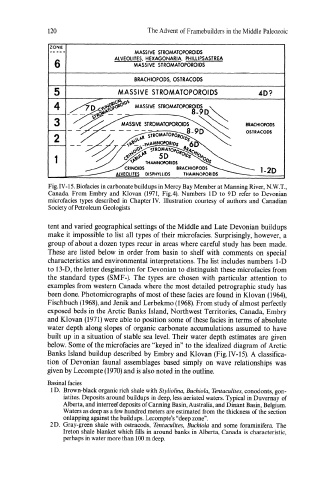
               Fig.IV-1S. Biofacies in carbonate buildups in Mercy Bay Member at Manning River, N.W.T.,
               Canada.  From  Embry  and  Klovan  (1971,  Fig.4).  Numbers  1 D  to  9D  refer  to  Devonian
               microfacies  types  described  in  Chapter IV.  Illustration  courtesy  of authors  and  Canadian
               Society of Petroleum Geologists

               tent and varied geographical settings of the Middle and Late Devonian buildups
               make it  impossible to list all  types  of their microfacies.  Surprisingly, however, a
               group of about a dozen types recur in areas where careful study has been made.
               These are listed  below in  order from  basin  to  shelf with  comments  on  special
               characteristics and environmental interpretations. The list includes numbers  I-D
               to 13-D, the letter desgination for Devonian to distinguish these microfacies from
               the  standard  types  (SMF-).  The  types  are  chosen  with  particular  attention  to
               examples from western Canada where the most detailed petrographic study has
               been done. Photomicrographs of most of these facies are found in Klovan (1964),
               Fischbuch (1968), and Jenik and Lerbekmo (1968). From study of almost perfectly
               exposed beds in the Arctic Banks Island, Northwest Territories, Canada, Embry
               and Klovan (1971) were able to position some of these facies in terms of absolute
               water depth along slopes  of organic carbonate accumulations  assumed to  have
               built up in a  situation of stable sea level.  Their water depth estimates  are given
               below. Some of the microfacies are "keyed in" to the idealized diagram of Arctic
               Banks Island buildup described by Embry and Klovan (Fig. IV-IS).  A classifica-
               tion  of Devonian faunal  assemblages  based  simply  on  wave  relationships  was
               given by Lecompte (1970) and is also noted in the outline.
               Basinal facies
                1 D.  Brown-black organic rich shale with Styliolina, Buchiola, Tentaculites, conodonts, gon-
                   iatites. Deposits around buildups in deep, less aeriated waters. Typical in Duvernay of
                   Alberta, and interreef deposits of Canning Basin, Australia, and Dinant Basin, Belgium.
                   Waters as deep as a few hundred meters are estimated from the thickness of the section
                    onlapping against the buildups. Lecompte's "deep zone".
                2D.  Gray-green  shale  with  ostracods,  Tentaculites,  Buchiola  and  some  foraminifera.  The
                   Ireton shale blanket which fills  in around banks in Alberta, Canada is  characteristic,
                    perhaps in water more than 100 m deep.

